Rowan Wilson’s Effort to Recast New York’s Highest Court
A reported profile of Chief Judge Rowan Wilson’s path to New York’s highest court, his problem-solving agenda and the limits on his authority.
File Summary
Rowan Wilson leads both New York’s Court of Appeals and its statewide court system, giving him influence over legal doctrine and the machinery through which millions of disputes move. His emerging record joins an effort to expand the high court’s docket with a broader administrative project: treating courts as institutions capable of addressing underlying human problems. The constraint is that judges must preserve neutrality while depending on other branches for money, staffing and new judgeships. (prod.publiccourtofappeals.nycourts.gov)
Standard of Proof
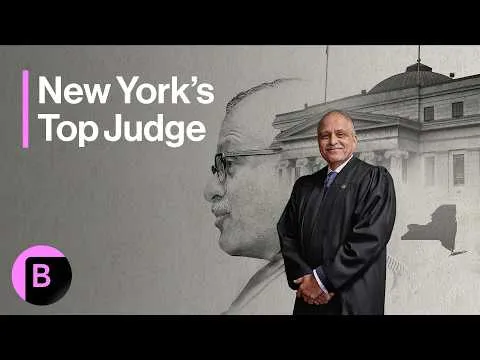
This profile draws on the current Court of Appeals roster and biography, Senate confirmation records, Court of Appeals annual reports, Wilson’s 2024 and 2026 State of the Judiciary remarks, court-system interviews and the Bloomberg Television feed description published October 23, 2026. Personal history is included only where Wilson or an official record supplied it; disputed political assessments are attributed. (prod.publiccourtofappeals.nycourts.gov)
Established Facts
- Wilson is currently chief judge of both the State of New York and the Court of Appeals. (prod.publiccourtofappeals.nycourts.gov)
- He served as a Court of Appeals associate judge from February 2017 until becoming chief judge in April 2023. (prod.publiccourtofappeals.nycourts.gov)
- He was a Cravath lawyer from 1986 until February 2017 and handled corporate, constitutional, employment and civil-rights matters. (prod.publiccourtofappeals.nycourts.gov)
- His administrative agenda emphasizes Family Court, problem-solving courts, civil legal services, civic education and a larger Court of Appeals docket. (nycourts.gov)
Principal Entities
- Rowan D. Wilson — Chief Judge of the State of New York and the New York Court of Appeals; the subject of this profile.
- New York Court of Appeals — The state’s seven-member highest court, which Wilson leads while holding one vote in its collective decisions.
- New York State Unified Court System — The statewide judiciary Wilson oversees with Chief Administrative Judge Joseph Zayas.
- Joseph A. Zayas — Chief Administrative Judge responsible for court operations and a central partner in Wilson’s administrative program.
- Kathy Hochul — New York governor who nominated Wilson as chief judge in April 2023 and works with the judiciary on budgets and judgeships.
- New York State Senate — The legislative chamber that confirmed Wilson and controls legislation and funding essential to parts of his agenda.
Chronology
- — Wilson graduated from Harvard Law School and began a clerkship with James R. Browning, then chief judge of the U.S. Court of Appeals for the Ninth Circuit.
- — He joined Cravath, Swaine & Moore, where he later became a partner and remained until entering the judiciary.
- — The New York State Senate confirmed Wilson as an associate judge of the Court of Appeals.
- — The Senate confirmed Wilson as chief judge after his nomination by Gov. Kathy Hochul. He became New York’s first Black chief judge.
- — The court decided 120 appeals, up from 88 in 2023, returning its output to a level comparable with the period before the COVID-19 disruption.
- — Wilson devoted his State of the Judiciary address to Family Court resources, services and institutional reform.
Evidence Record
Wilson’s stated priorities have produced identifiable institutional changes, though not all can be attributed to him alone. The Court of Appeals decided 120 appeals in 2024, compared with 88 in 2023. By February 2026, Wilson reported that lawmakers and the governor had created 29 Family Court judgeships, nonjudicial Family Court staffing had risen 21% over two years, and court-based children’s centers had increased from 16 in 2024 to 26. He said backlogs had fallen substantially but remained too high. (nycourts.gov)
Not Established
- The Bloomberg Television feed description does not include a transcript, so it does not establish Wilson’s precise statements in the interview or support broader claims about his motives and personal life.
- Public records reviewed here do not establish that Wilson alone caused changes in caseloads, backlogs or court services. Those outcomes also depend on fellow judges, administrators, legislators, executive officials and court employees.
- The available evidence does not yet measure the long-term effects of Wilson’s problem-solving model on statewide public safety, litigant outcomes or confidence in the courts.
Open Questions
- Will the planned Family Court mental-health treatment parts receive funding and progress from a budget proposal to operation?
- How fully will the court system implement recommendations expected from the Family Justice Initiative and the Permanent Commission on Justice for Families?
- Can the Court of Appeals sustain a larger docket while maintaining the deliberation and attention to individual cases that Wilson says matter more than volume?
- Will expanded problem-solving practices produce measurable improvements across courts, rather than isolated results in selected programs?
The File
Rowan Wilson’s significance rests in the unusual reach of his office. As chief judge, he presides over New York’s highest court, where seven judges settle questions of state law. He also heads a sprawling court system responsible for criminal proceedings, commercial litigation, housing conflicts, custody cases and other disputes that shape daily life. The first role demands decisions in individual appeals. The second forces him to confront budgets, staffing shortages, courthouse practices and entrenched backlogs.
Wilson has tried to connect the two through a view of judging centered on the people inside each case. In his first State of the Judiciary address as chief judge, delivered in February 2024, he argued that courts should not see themselves exclusively as places for deciding which party is legally right. In suitable cases, he said, they should also ask what response could best address the problem that brought the parties to court. He pointed to treatment courts, community courts and diversion programs as models, while acknowledging that their approaches cannot simply replace conventional adjudication. (nycourts.gov)
That philosophy has roots in a biography that differs from the traditional path of a career public-sector judge. Born in Pomona and raised in Berkeley, California, Wilson graduated from Harvard College in 1981 and Harvard Law School in 1984. He clerked for federal appellate judge James R. Browning before joining Cravath, Swaine & Moore in 1986. His practice ranged across antitrust, securities, intellectual property, employment, civil-rights and constitutional disputes. He became the firm’s first partner of color and stayed until his appointment to the Court of Appeals in 2017. (prod.publiccourtofappeals.nycourts.gov)
In a 2023 interview published by the court system, Wilson connected his emphasis on empathy to childhood responsibilities. His mother was blind, and he described reading material to her and learning satisfaction from helping others. That account does not by itself explain his jurisprudence. It does, however, provide his own stated context for the management style he later described: asking local judges and employees what works, what fails and what each courthouse needs instead of imposing uniform answers from the top. (nycourts.gov)
Wilson arrived at the center seat after a politically charged selection process. Hochul nominated him on April 10, 2023, after the Senate rejected her earlier nominee, Hector LaSalle. The Senate confirmed Wilson eight days later, making him New York’s first Black chief judge. Supporters portrayed his opinions and dissents as evidence of intellectual independence and sensitivity to civil rights. Republican critics argued that parts of his criminal-law record gave insufficient weight to victims and public safety. Those competing assessments followed him into an office that is judicial but cannot escape political scrutiny. (governor.ny.gov)
His authority over the Court of Appeals is real but bounded. Wilson can set an institutional tone, participate in decisions about which civil appeals receive review and decide criminal leave applications assigned to him. He cannot command six colleagues’ votes. The court’s output nevertheless began moving toward a goal he had articulated: hearing more cases of statewide significance. It decided 120 appeals in 2024, including 45 criminal appeals, compared with 88 total appeals in 2023. The annual report attributed the increase to calendaring more cases and arranging substitute judges when members could not participate—not to any single jurist. (nycourts.gov)
The broader test of Wilson’s leadership lies below the appellate court. His 2026 State of the Judiciary address concentrated on Family Court, which he called vital, difficult and chronically under-resourced. He credited the Legislature and governor with creating 29 judgeships and reported increases in support magistrates, employees, children’s centers and judicial training. He also acknowledged that backlogs remained too large. A permanent commission was assigned to develop reforms involving foster care, child support, custody, intimate-partner violence and juvenile justice. (nycourts.gov)
This is where Wilson’s ambition meets the structure of government. New judgeships require legislation. Expanded services require appropriations. Programs depend on administrators, local judges, lawyers and community providers. Even successful pilots do not prove that the same model will work in every county or type of case.
Wilson’s project is therefore less a unilateral transformation than an attempt to redirect a complex institution: increase the high court’s engagement with consequential legal questions while making lower courts more attentive to the circumstances that produce litigation. Whether that approach reshapes New York justice will depend not only on the opinions bearing his name, but on whether the system can turn an articulated philosophy into durable, measured practice.
Update Record
Public records were reviewed through October 24, 2026. The official Court of Appeals roster continued to identify Wilson as chief judge. This profile incorporates the February 9, 2026 State of the Judiciary address and the court’s published 2024 performance figures; it does not treat the Bloomberg video’s October 23 publication date as the date of a new judicial appointment or policy action. (nycourts.gov)