Trump-Xi summit diplomacy buys breathing space, but not necessarily for China alone
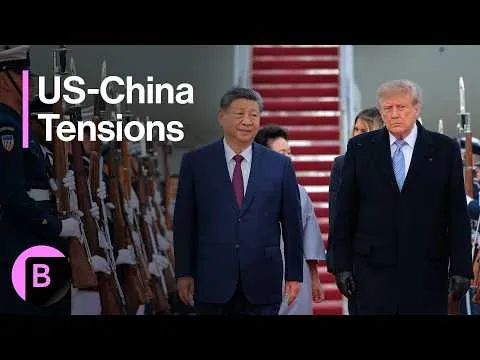
Repeated Trump-Xi meetings can reduce immediate friction and postpone costly decisions, but they do not by themselves show that Xi Jinping is seeking delay because of economic weakness. The stronger interpretation is that both governments are using summit diplomacy to preserve room for maneuver while structural disputes remain unresolved.
Overview
Stephen Roach’s argument that Xi may be using meetings with Donald Trump to buy time is plausible but unproven. China has economic reasons to limit another escalation, while repeated summits, working groups and official dialogues give Beijing breathing space without requiring a comprehensive settlement. Yet the same arrangement serves Washington, and China’s latest growth data do not indicate an immediate crisis. The meetings are therefore better understood as reciprocal risk management than clear evidence of a one-sided delaying strategy.
Facts
- Trump and Xi held talks in Beijing on May 14, 2026, during a US presidential state visit to China. (mfa.gov.cn)
- Xi and Trump met again at the White House on September 24, 2026. Both governments described a framework of constructive strategic stability. (mfa.gov.cn)
- The September meeting operationalized bilateral boards covering trade and investment, according to the White House. (whitehouse.gov)
- Both governments said the leaders intended to support each other’s hosting of the APEC and G20 summits later in 2026. (mfa.gov.cn)
- China’s preliminary official data showed gross domestic product rising 4.5% year on year in the third quarter and 4.6% over the first three quarters of 2026. (stats.gov.cn)
Main narrative
Roach’s thesis rests on a recognizable strategic logic. A government facing weak domestic demand, property-sector strains and external trade pressure has an incentive to prevent confrontation with its largest geopolitical competitor from becoming less predictable. Leader-level meetings can freeze escalation, keep technical negotiations operating and postpone decisions that would impose immediate economic costs.
That mechanism is visible in the institutional architecture surrounding the 2026 meetings. The May talks in Beijing produced a jointly stated vision of strategic stability. The September visit moved beyond that formulation by activating government-to-government boards on trade and investment and continuing dialogue on artificial intelligence and other contested issues. The leaders also indicated that they would attend summits hosted by the other country later in the year. (whitehouse.gov) Even without a comprehensive agreement, this calendar creates repeated opportunities to renew temporary understandings and discourages either bureaucracy from taking steps that could derail the next presidential encounter.
For Beijing, that breathing space has value. China’s official data showed the economy expanding through September, but the composition was uneven: third-quarter construction contracted 4.4% from a year earlier and real estate activity declined 0.4%, while manufacturing and services grew. (stats.gov.cn) Those figures support the narrower proposition that Chinese leaders have reasons to avoid an additional external shock. They do not establish that economic distress forced Xi into summit diplomacy or that delay is his principal objective.
The stronger counterpoint is that summitry may reflect confidence and opportunity as much as vulnerability. Beijing’s public account depicts direct presidential engagement as a way to manage competition, secure recognition of its positions and bind Washington to an agreed vocabulary of stability. During the September talks, Xi also pressed China’s established position on Taiwan, demonstrating that engagement did not require shelving a central political demand. (mfa.gov.cn) A strategy can seek stability while continuing to contest the underlying balance of power.
Washington likewise benefits from postponement. The Trump administration can claim progress, preserve negotiations on trade and illicit chemical controls, and retain leverage without immediately choosing between escalation and a politically difficult broad settlement. The White House’s emphasis on Trump’s friendship with Xi is therefore part of its own political presentation; it is not evidence that Beijing shares the same personal interpretation.
The bounded judgment is that the summits are buying time, but probably for both governments. Their practical function is to transform open-ended strategic competition into a sequence of manageable deadlines, dialogues and leader-level decisions. Roach may be right that China’s economic pressures increase Xi’s appetite for that arrangement. The available record does not establish that Xi is merely stalling, nor that personal rapport can sustain the process once either side concludes that delay no longer serves its interests.
Context / evidence
The Bloomberg item published on October 20 establishes Roach’s interpretation, not Xi’s intent: its available synopsis contains no evidence from Chinese deliberations or negotiating instructions. Official US and Chinese records independently establish the May and September meetings and the institutions they created, but those documents are public diplomatic accounts rather than neutral assessments of outcomes. Economic evidence is also mixed. China’s third-quarter growth accelerated from the second quarter, although official data showed construction and real estate contracting year on year, consistent with continuing domestic vulnerabilities. (stats.gov.cn)
Impact
The immediate observed effect is greater reliance on executive diplomacy and bilateral bodies rather than a comprehensive settlement. That concentrates decisions in the White House, China’s senior leadership and economic teams led by the US Treasury and Chinese vice-premier-level officials. It can provide businesses and agencies with short planning windows, but leaves policy sensitive to presidential decisions and summit schedules. For other governments, particularly US allies in Asia, temporary stability may lower near-term disruption while preserving uncertainty over tariffs, technology controls and Taiwan policy. Those broader effects remain contingent on implementation, not ceremony alone. (whitehouse.gov)
Outlook
The next tests are institutional rather than ceremonial. If Trump and Xi attend the APEC and G20 meetings as their governments intend, any bilateral encounters will matter most if they produce published implementation steps, durable tariff arrangements or functioning crisis-management channels. The planned bilateral exchange on artificial intelligence by November is one near-term indicator. (whitehouse.gov) Renewed tariffs, export restrictions or sharper language over Taiwan would instead show that summit diplomacy is only containing disputes temporarily. Without evidence from Chinese decision-making, claims about Xi’s motive should remain conditional.