Harman’s ‘Freefall’ Warning Is Really an Argument About Congress, Not the Absence of US Plans
The Trump administration has published strategies and advanced diplomatic initiatives, but Harman’s sharper point is that Congress has not converted contested foreign-policy choices into durable national commitments.
Overview
Jane Harman’s warning that US foreign policy is in “freefall” overstates the absence of policy: the Trump administration has an official national-security strategy and identifiable initiatives for Ukraine and Gaza. Her stronger argument concerns institutional ownership. Major choices remain heavily dependent on executive discretion, while Congress often debates but does not settle questions of force, funding and strategic priorities. That imbalance matters because policies lacking legislative participation can be easier to reverse, harder to scrutinize and less credible as long-term commitments.
Facts
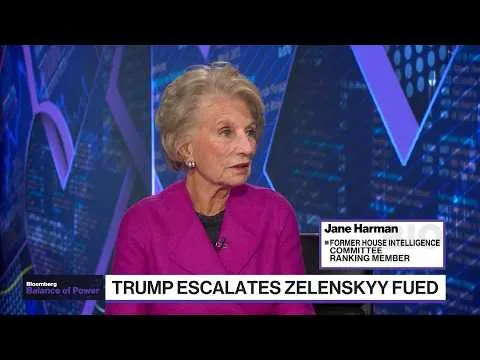
- Bloomberg Television published Harman’s interview on October 19, 2026. She described US foreign and security policy as being in “freefall” and argued that Washington lacks strategies for Ukraine and the Middle East.
- Harman served nine terms in the House and spent four years as the ranking Democratic member of the House Intelligence Committee, according to her NASA Advisory Council biography. (nasa.gov)
- The administration’s 2025 National Security Strategy presents an “America First” framework centered on narrowly defined US interests, deterrence, economic leverage and unconventional diplomacy. (whitehouse.gov)
- On June 27, 2025, the Senate voted 47-53 against advancing a resolution directing the removal of US forces from unauthorized hostilities against Iran. (congress.gov)
Main narrative
Harman’s diagnosis combines two distinct propositions. The first is strategic: Washington has no coherent approach to Ukraine or the Middle East, Russian leader Vladimir Putin is exploiting President Donald Trump, and Chinese leader Xi Jinping has pursued a more successful long-term course. The second is institutional: Congress has surrendered too much of its policymaking role. The available record makes the second proposition more persuasive than the categorical version of the first.
The administration cannot accurately be described as having produced no strategy. Its 2025 National Security Strategy defines an “America First” approach, narrows the stated national interest and emphasizes strength, economic leverage and presidential dealmaking. (whitehouse.gov) In January 2026, the White House described a 20-point Gaza plan involving transitional governance, reconstruction, international financing and a stabilization force. That is an articulated framework, although the administration’s announcement does not independently establish implementation or success. (whitehouse.gov)
There is also continuing diplomacy concerning Ukraine. On October 23, after Harman’s interview was published, the White House announced that Russia and Ukraine had agreed to a temporary, localized ceasefire in Oleshky for humanitarian access and evacuation. The pause was scheduled to begin on October 29, six days after the announcement; as of the October 24 editorial reference date, its commencement and results were not yet established. (whitehouse.gov) A limited humanitarian arrangement would not itself amount to a strategy for ending the wider war, but it complicates any claim of total policy paralysis.
The more consequential question is what “strategy” means. A document can list principles, and an administration can pursue separate negotiations, without resolving how regional initiatives fit together, what trade-offs Washington will accept, how success will be measured or which commitments will survive a change of president. On that definition, Harman is challenging coherence and durability rather than the literal existence of plans.
Congress remains the missing institutional anchor
Her criticism of Congress identifies a mechanism for that weakness. Legislators possess appropriations, authorization, oversight and confirmation powers, yet exercising them requires majorities willing to accept responsibility for an explicit course. The Senate’s June 2025 consideration of unauthorized hostilities against Iran illustrates the distinction between possessing authority and using it decisively: senators debated a war-powers mechanism, but the chamber voted 47-53 against advancing the withdrawal resolution. (congress.gov) That outcome did not eliminate congressional power; it left the executive’s position undisturbed.
A credible counterpoint is that flexibility can be strategically useful. Presidents can negotiate quickly, conceal bargaining positions and respond to crises faster than a divided legislature. Congressional micromanagement can also produce contradictory mandates. But speed is not a substitute for political consent when commitments involve sustained funding, military risk or obligations extending beyond one administration. Executive flexibility and congressional ownership are not mutually exclusive: Congress can define objectives and limits while leaving operational decisions to the president.
Harman’s “freefall” description is therefore best treated as a warning, not an established condition. The evidence shows active presidential policy, not an empty field. It also shows why announcements alone may not supply the consistency she demands. The unresolved issue is whether Congress will transform disagreement into binding choices—or continue allowing presidents to define the scope, duration and acceptable costs of American engagement.
Context / evidence
The constitutional record supports Harman’s focus on Congress without proving her broader assessment. Congress holds powers over declarations of war, appropriations, armed-force rules and legislation, while presidents claim substantial authority to deploy force. Courts have generally avoided resolving the resulting boundary. (constitution.congress.gov) A Congressional Research Service briefing also identifies legislation, funding, oversight, confirmations and war-powers procedures as tools available to lawmakers confronting Ukraine, Middle East and China policy. (congress.gov) These records establish capacity, not whether any particular congressional choice is correct.
Impact
The immediate institutional effect of congressional restraint is wider presidential control over timing, bargaining and the interpretation of US commitments. The June 2025 Senate vote on Iran left the challenged military posture in place rather than imposing withdrawal through that resolution. (congress.gov) More broadly, the implication—not a measured outcome—is that allies, adversaries and agencies must distinguish between presidential initiatives and commitments supported through legislation and appropriations. For lawmakers, reassertion would require politically costly votes on objectives, funding and limits, not simply criticism at hearings or in media appearances.
Outlook
The test of Harman’s argument will be institutional rather than rhetorical. Congress could give policies greater durability by attaching clear objectives and reporting requirements to funding, voting directly on military authorities and using oversight to test whether announced diplomatic frameworks are producing their stated results. Alternatively, lawmakers may continue to contest presidential decisions without replacing them with enacted policy. Indicators include future war-powers votes, conditions on security assistance, public implementation benchmarks for Gaza and Ukraine initiatives, and evidence after October 29 that the scheduled Oleshky ceasefire actually began. None alone would establish a comprehensive strategy, but together they would show whether policy is becoming more accountable and durable.