Paul Mackenzie: The preacher convicted in Kenya’s 191 Shakahola murders
A documented profile of Paul Nthenge Mackenzie, the Good News International leader convicted over the deaths of 190 children and one adult at Shakahola.
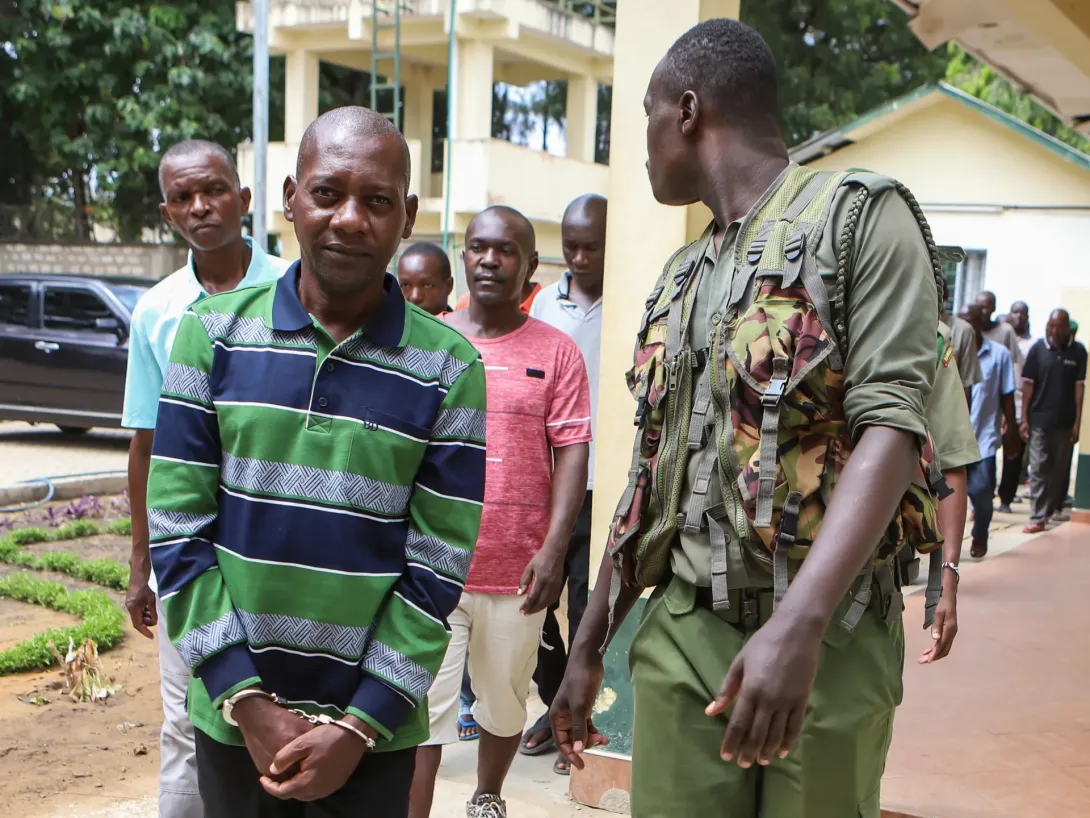
File Summary
Paul Nthenge Mackenzie turned an apocalyptic ministry into an isolated community at Shakahola, where a Kenyan court found that religious authority, enforced fasting and organised surveillance were used to cause deaths. On October 19, 2026, he and 28 co-defendants were convicted of murdering 190 children and one adult. The verdict establishes criminal responsibility for those 191 deaths, while separate cases and investigations remain unresolved. (apnews.com)
Standard of Proof
This profile uses the October 19, 2026 conviction as the controlling record for criminal responsibility, supported by contemporaneous court reporting. Earlier history is drawn from published Kenyan court rulings, the Senate’s 2023 Shakahola report and the national human-rights commission’s 2024 findings. Institutional allegations are attributed rather than presented as verdicts. Biographical details that could not be established from these records are omitted. (new.kenyalaw.org)
Established Facts
- Mackenzie founded Good News International Ministries in 2003; it was formally registered in 2010. (knchr.org)
- The ministry operated a broadcasting company associated with Times TV.
- Its activities shifted from Malindi toward the remote Shakahola area around 2019–2020.
- Authorities recovered 429 bodies by the end of the 2023 exhumation operation, according to the human-rights commission.
- On October 19, 2026, Mackenzie and 28 others were convicted over 191 deaths—190 children and one adult. (apnews.com)
Principal Entities
- Paul Nthenge Mackenzie — Founder and leader of Good News International Ministries; convicted on October 19, 2026, in the 191-count murder case.
- Good News International Ministries — The religious organisation founded by Mackenzie in 2003 and formally registered in 2010.
- Justice Diana Kavedza-Mochache — High Court judge who delivered the October 19 murder judgment.
- Kenya National Commission on Human Rights — Constitutional commission that investigated Shakahola, interviewed survivors and documented alleged institutional failures.
- Kenyan Senate Ad Hoc Committee on Shakahola — Parliamentary body that examined the ministry, the deaths and the response of state agencies.
Chronology
- — The Kenya National Commission on Human Rights says Paul Nthenge Mackenzie founded Good News International Ministries.
- — The organisation was registered as a religious society, with Mackenzie listed as chairman.
- — Good News Media (K) Limited, associated with the ministry and its Times TV operation, was registered.
- — The Malindi church premises closed and operations shifted toward Shakahola. Official reports differ on whether the relocation occurred in 2019 or 2020.
- — Reports of deaths prompted investigations, rescue operations and the discovery of mass graves at Shakahola. Mackenzie was arrested in April.
- — Mackenzie and 30 other defendants were brought before the High Court on 191 murder counts. Mackenzie denied the charges.
- — The Court of Appeal allowed prosecutors to proceed with all 191 murder counts after the High Court had directed that the number be reduced.
- — The High Court convicted Mackenzie and 28 co-defendants of murdering 190 children and one adult.
- — Mitigation and sentencing proceedings are scheduled; these events had not occurred by the October 20 editorial cutoff.
Evidence Record
Contemporary accounts of the October 19 judgment report that the court found the prosecution had proved an organised system of fatal fasting beyond reasonable doubt. Testimony and forensic material addressed starvation, violence against people who resisted, the withholding of food and the concealment of graves. The judgment covered 191 deaths, not every death associated with Shakahola. Earlier parliamentary and human-rights findings documented isolation, destroyed identity papers and warnings to authorities, but those institutional reports are distinct from the criminal verdict. (citizen.digital)
Not Established
- The public record reviewed does not establish Mackenzie’s date of birth, formal education, complete early employment history or the private experiences that shaped his beliefs.
- The available evidence does not establish a complete accounting of the ministry’s finances, property transfers or membership across Kenya.
- The murder verdict does not decide Mackenzie’s separate terrorism and manslaughter cases, in which he has pleaded not guilty.
Open Questions
- What sentences will the High Court impose after the mitigation hearing scheduled for October 30, 2026?
- Will Mackenzie or any co-defendant appeal after sentencing, which is scheduled for November 6?
- How will the separate terrorism and manslaughter proceedings be resolved?
- Will continuing investigations identify more victims and produce additional accountability for deaths not covered by the 191-count judgment?
The File
Paul Nthenge Mackenzie’s public record is not primarily a conventional biography. It is the history of an institution built around his authority: first a church in coastal Kenya, then a media operation, and eventually an isolated settlement where followers were directed to reject institutions outside his religious system.
That record reached its most consequential legal turning point on October 19, 2026. The High Court convicted Mackenzie and 28 co-defendants of murdering 190 children and one adult. Reports of the judgment say the court concluded that Mackenzie oversaw an organised structure in which apocalyptic teaching was translated into enforced fasting, surveillance and violence. Sentencing is scheduled for November 6, after a mitigation hearing set for October 30. (apnews.com)
Building authority beyond a church
The Kenya National Commission on Human Rights says Mackenzie founded Good News International Ministries in 2003. The organisation was registered in 2010, with Mackenzie recorded as chairman, and later established Good News Media (K) Limited, associated with Times TV. The combination of congregation and broadcasting gave his sermons a reach extending beyond worship meetings in Malindi.
Official investigations described his doctrine as hostile to formal education, medical treatment and government authority. Those positions were not incidental to the later case. The October 2026 judgment, according to reporting from the proceedings, identified the rejection of education and healthcare, social isolation and relocation to Shakahola as parts of the system through which followers were controlled. (libraryir.parliament.go.ke)
Mackenzie’s encounters with authorities preceded the discovery of the graves. The human-rights commission documented arrests beginning in 2017 involving allegations or offences connected to children’s education, radicalisation, unauthorised films and an unlicensed studio. Outcomes differed, and the record does not support treating every earlier allegation as a conviction. The commission later argued that repeated warnings should have triggered more effective investigation.
From Malindi to an isolated settlement
Official accounts differ slightly over the timing of the ministry’s move: the human-rights commission placed the relocation to Shakahola in 2019, while the Senate report said church operations moved there in 2020 after the Malindi premises closed. Both records describe a decisive change from a visible urban ministry to a remote community separated from schools, hospitals, transport and close outside scrutiny.
The Senate committee was told that followers surrendered possessions, destroyed identity and education documents and lived in settlements carrying biblical names. The human-rights commission reported that a fasting sequence placed children first, followed by women and men, with Mackenzie positioned to die last. It also reported allegations that armed enforcers guarded the settlement, supervised fasting and attacked people who resisted or attempted to escape. Those were institutional findings before trial; the 2026 court judgment subsequently found an organised fatal-fasting system proved in the 191 murder counts before it. (libraryir.parliament.go.ke)
The isolation helped convert doctrine into physical control. Followers were not merely being asked to accept an end-times prediction, according to the court’s findings as reported after the verdict. Children were denied food and water, guards prevented escapes, and people attempting to eat or leave were beaten or restrained. Mackenzie maintained during the proceedings that he had not forced followers to fast. The court rejected that defence. (apnews.com)
A conviction narrower than the full tragedy
Government search, rescue and exhumation operations recovered 429 bodies by October 2023, according to the human-rights commission. The October 2026 verdict, however, concerned 191 named counts: 190 children and one adult. The distinction matters. Mackenzie’s conviction establishes responsibility for the deaths adjudicated in that prosecution; it should not be expanded automatically to every body recovered or every person reported missing. (knchr.org)
Nor does the verdict conclude the entire legal record. Mackenzie faces separate manslaughter and terrorism-related proceedings and has pleaded not guilty in those cases. The October 19 decision was therefore both definitive and incomplete: definitive about guilt on the 191 murder counts, incomplete as an accounting of all deaths, all alleged participants and the failures that allowed the Shakahola community to operate despite years of warnings.
Mackenzie’s documented influence rested on more than apocalyptic preaching. The court record describes a hierarchy that connected religious instruction to administrators, guards, grave diggers and others who enforced or concealed the consequences. That structure—and the state’s delayed response—places his profile within a broader conflict over coercive authority, protection of children and the boundary between religious freedom and criminal conduct.
Update Record
Updated through October 20, 2026, to reflect the High Court’s October 19 conviction of Mackenzie and 28 co-defendants. Mitigation is scheduled for October 30 and sentencing for November 6; neither future proceeding is described as completed. (apnews.com)