Russia gains from the Iran war, but escalation limits Moscow’s room to exploit it
Moscow has gained oil revenue and sanctions relief from the conflict, yet uncontrolled escalation could threaten Iran, regional trade and Russia’s claim to diplomatic influence.
Overview
Russia has a measurable short-term interest in a contained US-Iran conflict: disrupted Gulf supplies have increased oil revenue and encouraged Washington to relax pressure on Russian energy. The evidence does not show that Moscow wants unlimited escalation, however. Its more likely preference is a managed crisis that preserves Iran as a partner, protects elevated energy prices and gives Russia diplomatic leverage without triggering regional disorder it cannot control.
Facts
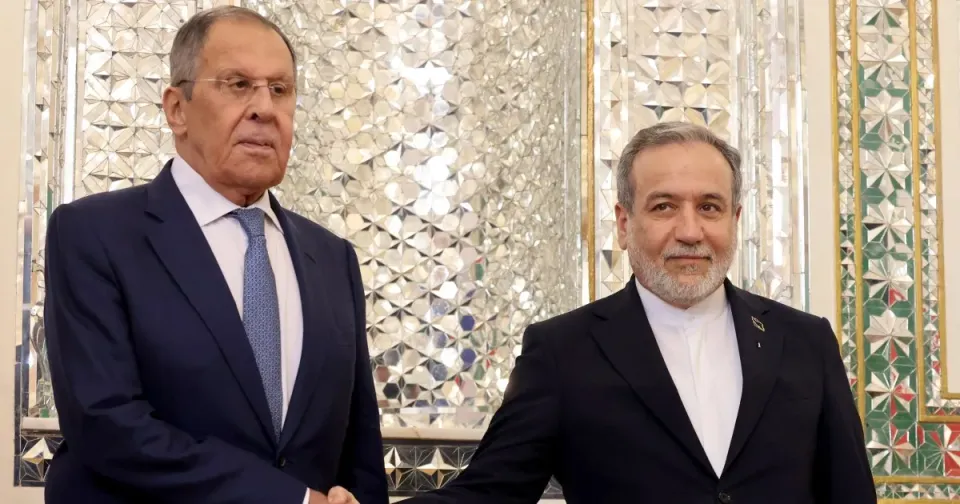
- Russian Foreign Minister Sergey Lavrov met Iranian Foreign Minister Abbas Araghchi and President Masoud Pezeshkian in Tehran on October 19, 2026. (aljazeera.com)
- The Russia-Iran comprehensive strategic partnership treaty entered into force on October 2, 2025; it is not a mutual-defence pact. (publication.pravo.gov.ru)
- Reuters calculated in April 2026 that Russia’s largest oil-tax revenue stream would roughly double to about $9bn as the Iran conflict lifted prices. (au.investing.com)
- The US Treasury issued General License 135 on October 9, 2026, authorising specified transactions involving Russian-origin diesel. (ofac.treasury.gov)
- Brent crude traded near $109.64 a barrel early on October 21 amid continuing concern about Middle Eastern supply and shipping. (marketscreener.com)
Main narrative
Lavrov’s October 19 visit displayed Russia’s central contradiction. Moscow publicly backed Tehran and condemned US and Israeli military action, while also presenting itself as a possible channel for de-escalation. Those positions are compatible if Russia’s objective is not simply victory for Iran or a rapid end to the conflict, but preservation of Russian influence over both the crisis and its eventual settlement. (aljazeera.com)
The economic incentive is unusually visible. Disruption around the Strait of Hormuz raised the value of exports from producers able to supply markets outside the Gulf. Reuters calculated that Russia’s principal oil tax would bring in about $9bn in April, roughly twice the previous month’s level. In October, Washington also authorised transactions involving Russian diesel and waived key Russia-related sanctions and tariffs before they took effect. These decisions were framed around US national interests as energy costs remained politically sensitive before the November 3 midterm elections. (au.investing.com)
The result is a strategic opening for Moscow. High prices increase state revenue, while Western demand for alternative supplies weakens efforts to isolate Russian energy. At the same time, Washington’s desire to keep Russia involved in Ukraine diplomacy gives the Kremlin another arena in which to connect otherwise separate negotiations. John Lough of Chatham House argued that Moscow was using the energy squeeze and Ukraine talks to align Russian and US interests; that is an analyst’s assessment, not proof of a coordinated bargain. (aljazeera.com)
But the benefits decline if escalation becomes uncontrollable. Russia could lose an important security and commercial partner if Iran’s state capacity is severely degraded. Wider attacks on Gulf infrastructure or shipping could also produce unpredictable military responses, threaten Russian projects and damage Moscow’s relations with Gulf governments. Lavrov travelled to Tehran after meeting Gulf Cooperation Council representatives who wanted Russia to encourage dialogue and restored shipping through Hormuz, illustrating the competing relationships Moscow must manage. (aljazeera.com)
Russia therefore has reasons to favour neither immediate normalisation nor an expanding regional war. A prolonged but bounded confrontation preserves high energy prices, increases demand for Russian diplomacy and keeps Tehran dependent on external support. This is an inference from observable incentives, not evidence that Russia caused, prolonged or secretly directs the conflict. Moscow’s ability to sustain that balance is also uncertain: it can communicate with the parties, but communication alone does not establish leverage over their military decisions.
Context / evidence
The relationship rests on reciprocal utility rather than an obligation to fight together. Iran has supplied military technology used by Russia in Ukraine, while Moscow offers diplomatic cover, trade and strategic cooperation. The European Union’s sanctions framework identifies Iranian drone and missile transfers as support for Russia’s war. (consilium.europa.eu) Their treaty institutionalises cooperation but omits the mutual-defence commitment that would automatically convert partnership into direct Russian intervention. (publication.pravo.gov.ru)
Counterpoint / knowledge gaps
The strongest alternative reading is that Moscow genuinely prioritises ending the war because the loss or destabilisation of Iran would outweigh temporary energy gains. Lavrov’s offer to facilitate a settlement and Russia’s continued engagement with Gulf governments support that interpretation. Yet public diplomacy does not establish Moscow’s private preferences. The key gaps are whether Russia is materially assisting Iran, what concessions it has proposed to Washington or Tehran, and whether its economic gains are influencing its negotiating position. Without that evidence, claims of deliberate Russian obstruction remain unproven.
Impact
For Iran, Russia’s approach offers diplomatic support but no guaranteed military protection; the bilateral treaty contains no mutual-defence clause. For Gulf states and commercial shipping, Moscow’s practical value depends on whether its access to Tehran produces restraint or safer transit, neither of which was established by the October 19 meetings. For Ukraine and its supporters, the clearest observed consequence is economic: elevated energy revenue and US sanctions relief give Russia additional resources and reduce, at least temporarily, external pressure on its export sector. (publication.pravo.gov.ru)
Outlook
Three indicators will test this assessment. First, Russian arms deliveries, intelligence support or military deployments would show that protecting Iran is overtaking Moscow’s caution. Second, concrete Russian proposals accepted by either Washington or Tehran would demonstrate real mediation rather than positioning. Third, falling oil prices or renewed US sanctions would weaken the immediate economic benefit of the crisis. Until one of those shifts occurs, Moscow is likely to support negotiations while resisting an outcome that removes its energy windfall or reduces its regional relevance.