Huang’s neocloud case is strongest on AI demand—and weakest on financing risk
Nvidia’s chief says soaring demand makes specialist AI clouds attractive. Public filings show real contracted demand, but also debt, concentration and contingent capacity risk.
Overview
Jensen Huang’s endorsement is credible as a diagnosis of demand, but not yet as a blanket investment conclusion. Nvidia and CoreWeave records show rapid growth, large customer commitments and financing structures designed to unlock further capacity. Returns still depend on operators delivering that capacity, keeping it utilized and earning enough to cover debt, leases, power and hardware renewal. Nvidia’s interests are also distinctive: it can benefit from equipment sales, ecosystem growth and revenue sharing while project lenders and investors retain substantial downside.
Facts
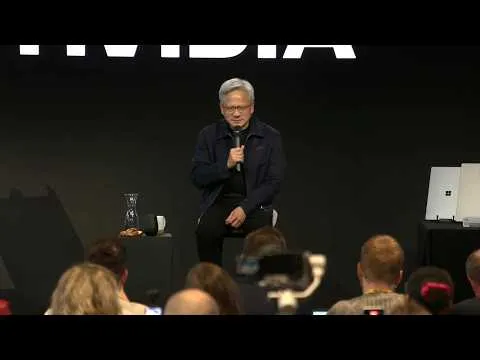
- Bloomberg Television published an interview clip on October 22, 2026, in which Nvidia CEO Jensen Huang called neoclouds a “good investment,” described demand for their computing capacity as exceptional and identified working capital as a constraint.
- Nvidia’s August 26, 2026, earnings transcript said its sovereign AI business, conducted primarily through regional neoclouds, grew 35% sequentially and more than tripled year over year during its fiscal second quarter.
- Nvidia described providing take-or-pay commitments for part of some neocloud facilities’ capacity in return for a share of revenue earned above a minimum level.
- CoreWeave reported $103.7 billion of remaining performance obligations and $35.551 billion of total debt as of June 30, 2026. It also recorded $16.3 billion of operating lease liabilities.
- Nvidia’s fiscal second-quarter filing said some agreements require it to purchase capacity that AI clouds fail to sell. It also said memorandums concerning platforms intended to mobilize more than $500 billion of third-party capital might not produce definitive agreements.
Main narrative
Huang’s argument starts with a genuine mismatch: customers want more AI computing capacity than many specialist cloud operators can finance. A neocloud must secure power, data-center space, networking equipment and expensive GPU systems before it can deliver contracted services and collect the associated revenue. Rapid demand can therefore increase, rather than eliminate, its immediate need for capital.
Nvidia is attempting to close that gap. In its August earnings call, the company described a structure under which it makes a take-or-pay commitment covering part of a facility’s capacity. That revenue floor can make a project easier for independent lenders to underwrite. Nvidia receives an additional share of rental revenue above the floor, supplementing its original hardware sale.
The mechanism supports Huang’s confidence: credible commitments can convert anticipated compute demand into financeable cash flows. It may also reduce reliance on one customer guaranteeing an entire facility, allowing capacity to be sold to several users. Nvidia separately announced memorandums with six large financial institutions intended to mobilize more than $500 billion over time, although its regulatory filing explicitly cautioned that those preliminary arrangements might not become final agreements.
Demand alone, however, does not settle whether a neocloud is a good investment. The demand must come from customers able and willing to pay, capacity must arrive when promised, and rental prices must produce adequate returns after financing, energy and operating costs. Hardware performance also evolves quickly, creating a continuing requirement to upgrade equipment or find economical uses for older systems.
CoreWeave illustrates both sides. Its $103.7 billion of remaining performance obligations at June 30 is evidence of extensive committed business, not simply an expression of customer interest. Yet remaining obligations are recognized only as services are delivered and can be adjusted for matters including delays and service credits. At the same date, CoreWeave carried $35.551 billion of debt and $16.3 billion of operating lease liabilities. Those obligations make delivery timing, utilization and refinancing conditions financially consequential.
Nvidia itself acknowledges the residual risk. Its quarterly filing says that, under agreements with AI clouds, it may have to purchase capacity that those operators fail to place with third parties. Nvidia could earn revenue sharing from successful rentals, but lower demand or pricing could reduce that return. The arrangement therefore does not abolish utilization risk; it reallocates part of it to the ecosystem’s most financially powerful participant.
That distinction also complicates the phrase “good investment.” Nvidia can gain relatively early through GPU sales and wider adoption of its software platform. A neocloud’s shareholders and creditors must wait for long-lived operating cash flows while absorbing construction, customer, interest-rate and refinancing exposure. The same project can consequently be strategically attractive to Nvidia while offering a less certain risk-adjusted return to outside capital.
Huang’s central claim is therefore strongest when read narrowly: neoclouds address demonstrably strong demand and financing innovation can help them expand. The available evidence does not establish that every operator, security or project is attractively priced. That judgment requires deal-level information about utilization, customer credit, contract margins, debt maturity, supplier guarantees and the residual value of computing equipment.
Context / evidence
The strongest evidence for Huang’s case is contractual rather than rhetorical. CoreWeave’s remaining performance obligations represent consideration allocated to services not yet delivered, although they are not equivalent to recognized revenue or collected cash. Its filing expected 41% of that balance to be recognized in the 24 months ending June 30, 2028. The counterweight is its fixed financial structure: substantial debt, lease obligations and scheduled payments must be serviced while facilities are constructed and customer capacity becomes available. Nvidia’s disclosures confirm that supplier support is part of the financing architecture, not merely promotional backing.
Impact
For neocloud operators, Nvidia-backed commitments can broaden access to project finance and accelerate deployments that their own balance sheets could not support. For AI developers and enterprises, that could expand access to scarce computing capacity beyond the largest diversified cloud providers. The plausible cost is deeper financial interdependence: delays or weaker utilization could affect operators, lenders, data-center landlords and Nvidia simultaneously. Investors must therefore distinguish expanding AI usage from sustainable operator economics. The reporting establishes financing activity and contractual demand, but not sector-wide profitability or investment success.
Outlook
The thesis would strengthen if Nvidia’s proposed financing platforms reach definitive agreements, operators diversify customers, delivered capacity remains highly utilized and operating cash generation rises after interest and infrastructure costs. It would weaken if projects face power or construction delays, contract prices decline, customers defer capacity, or refinancing becomes more expensive. Particularly important disclosures will be the size and duration of Nvidia’s capacity commitments, the proportion of projects financed without supplier support, and whether older GPU clusters can be renewed or re-leased economically. Public records available through October 23 do not provide those answers across the sector.
Sources
- Bloomberg Television: Nvidia's Huang Says Neoclouds Are 'Good Investment'
- NVIDIA Q2 Fiscal 2027 Earnings Call Transcript
- NVIDIA Fiscal 2027 Second-Quarter Form 10-Q
- NVIDIA AI Compute Infrastructure Financing Platforms Announcement
- CoreWeave Form 10-Q for the Quarter Ended June 30, 2026
- CoreWeave Second-Quarter 2026 Results