Hollywood’s AI fight shifts from adoption to control of labor, likeness and rights
A Bloomberg discussion highlights an industry entering a more consequential phase of AI adoption: the contest is increasingly about who controls reusable creative assets, permissions and compensation.
Overview
Hollywood’s AI debate is shifting from whether generative tools can assist production to who controls the resulting economic value. The technology may lower the cost of development, localization and digital production, but collective-bargaining agreements and California law increasingly condition those efficiencies on consent, disclosure and compensation. The bounded judgment is that AI will initially reorganize creative workflows more readily than it replaces entire professions. Its distributional effects will depend less on raw capability than on whether workers retain bargaining power over their writing, performances, likenesses and other reusable assets.
Facts
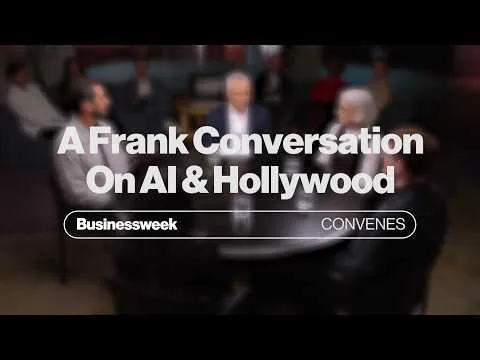
- Bloomberg Television published “Hollywood Executives Weigh AI’s Promise” on October 22, 2026. Its public description says four entertainment leaders discussed benefits, risks, jobs, ownership and creative control, but does not identify them or reproduce their positions.
- SAG-AFTRA members ratified the 2026 TV/Theatrical Agreement on June 4, 2026, by 91.42% to 8.58%. The agreement took effect July 1, 2026 and runs through June 30, 2030.
- The agreement extends protections to digital replicas created without a dedicated scan, requires security measures and restricts the use of wholly synthetic human performances.
- Writers Guild rules state that AI-generated material is not literary material, companies cannot require writers to use AI, and writers must be told when supplied material contains AI-generated content.
- The U.S. Copyright Office says AI-assisted work can receive copyright protection for human-authored expression, but prompts alone do not ordinarily establish authorship of an output.
Main narrative
The central economic feature of generative AI is not simply that it can produce text, images, voices or moving pictures. It is that creative material can become a reusable input: a performance can become a digital replica, an archive can become training data, and a generated draft can enter a workflow that previously began with paid human labor.
That changes bargaining because the party controlling the reusable asset may capture value across multiple stages or projects. Studios and technology providers could benefit from faster iteration, lower marginal production costs and the ability to modify or localize material without recreating every underlying element. Established performers and creators may also benefit if they can license valuable likenesses, voices, catalogues or specialized styles on favorable terms.
The risk falls most heavily on workers whose contributions are easier to fragment into tasks. AI does not need to replace a screenwriter, performer or production artist completely to change employment. If it performs preliminary drafting, background generation, temporary voice work or some forms of alteration, the number, duration or price of human assignments could decline. Entry-level roles may be especially exposed because they often involve the repeatable work through which people acquire experience and professional relationships.
Contracts turn technical capability into a rights question
Hollywood’s labor agreements increasingly intervene at the point where a technical capability becomes a commercial use. The WGA framework preserves the covered writer’s status by declaring that AI is not a writer and that generated material cannot be used to downgrade a writer’s compensation or credit position. It also allows a writer to choose AI with company consent, making the arrangement a regulated option rather than a categorical prohibition.
SAG-AFTRA’s 2026 agreement applies a related mechanism to performance. Its protections cover replicas derived from ordinary production photography as well as dedicated scans, reducing the possibility that a producer could escape contractual duties because no formal scanning session occurred. The agreement also requires an articulable business reason when seeking consent to scan, adds security and transfer protections, and establishes a stronger bargaining process around synthetic human performances.
These provisions do not demonstrate that AI has preserved or eliminated jobs. They instead redistribute decision rights. A producer’s ability to generate an asset does not automatically settle whether it may be used, for how long, in which production or for what payment. Consent, documentation and enforceability become part of the production infrastructure.
Copyright creates a second layer. The Copyright Office’s position that human-authored elements may be protected, while prompts alone generally do not confer authorship, gives companies an incentive to preserve evidence of meaningful human creative control. Its training report also rejects a single answer for every dataset or model use, distinguishing potentially transformative applications from commercial systems whose outputs compete with the works used to train them.
The likely near-term result is therefore uneven adoption rather than wholesale automation. Uses with clear permissions, measurable savings and limited reputational risk should advance fastest. Uses that depend on disputed training material, ambiguous ownership or replacement of recognizable human labor face higher legal and industrial-relations costs. Hollywood’s decisive AI capability may consequently be rights management: knowing what material entered a system, who authorized it, what the output contains and who must be paid.
Context / evidence
The framework has developed through several distinct records. California enacted performer-likeness protections in 2024. The WGA’s 2023 agreement established rules for AI in covered writing, while SAG-AFTRA’s contract effective July 1, 2026 expanded controls over replicas and synthetics. Separately, the Copyright Office’s January 2025 report addressed human authorship, and its May 2025 pre-publication training report argued that fair-use analysis depends on the particular use while encouraging voluntary licensing markets.
A credible counterpoint is that clearer rights may accelerate responsible adoption rather than impede it. The WGA permits voluntary, company-approved use, and federal guidance does not deny protection merely because AI assisted a human creator. Material gaps remain: the Bloomberg description supplies no transcript, and the available records do not quantify studio savings, jobs displaced or created, replica payments, synthetic-performer use or AI’s effect on project quality.
Impact
The clearest observed consequence is institutional: AI use in covered Hollywood work now carries more explicit consent, disclosure, security and bargaining obligations. Producers may need stronger systems for tracking source material, replica permissions, contract scope and downstream transfers.
For workers, these rules create enforceable leverage but not guaranteed employment. Creators with recognized names or controlled catalogues may gain licensing opportunities, while less powerful workers could face pressure if tasks are consolidated. For audiences and distributors, provenance affects reputational and legal risk: uncertainty over a voice, likeness or training source can complicate release, marketing and reuse even when an output is technically convincing.
Outlook
Three paths remain plausible. AI could develop mainly as an assistive layer, with workers using it for iteration while retaining authorship and compensation. Studios could instead automate selected tasks—particularly repetitive development, alteration or localization work—without eliminating complete occupations. A more disruptive scenario would require synthetic output to become consistently cheaper, acceptable to audiences and contractually defensible.
The strongest indicators will be production disclosures, licensing agreements, union notices, grievances or arbitration, replica compensation and changes in staffing and credits. Evidence of recurring paid licenses and stable employment would support an augmentation thesis. Falling entry-level hiring alongside expanding synthetic use would strengthen the displacement case.
Sources
- Bloomberg Television — Hollywood Executives Weigh AI’s Promise
- SAG-AFTRA Members Approve 2026 TV/Theatrical Contracts Tentative Agreement
- Writers Guild of America West — Artificial Intelligence
- U.S. Copyright Office — Copyright and Artificial Intelligence
- California Governor — Bills to Protect the Digital Likeness of Performers