Stephen Schwarzman’s AI turn: From a 2015 bus ride to Blackstone’s infrastructure bet
A documented profile of how Stephen Schwarzman moved from a chance 2015 AI conversation to university philanthropy and Blackstone infrastructure investments.
File Summary
Stephen Schwarzman’s account of discovering artificial intelligence begins with a chance 2015 conversation with Alibaba co-founder Jack Ma. The more consequential portrait lies in what followed: university gifts supporting computing and AI ethics, the construction of a data-science capability inside Blackstone, and large investments in the physical infrastructure behind AI. The record shows an investor translating an unfamiliar technology into an institutional priority, while leaving the encounter’s precise causal weight unproven.
Standard of Proof
This profile relies on Bloomberg Television’s dated preview, current institutional biographies, university records, company announcements and an official HKUST citation. Statements about the 2015 conversation are treated as Schwarzman’s recollection rather than an independently observed scene. Corporate scale and investment figures retain their stated dates, while planned capacity is not presented as completed. Private motives, informal discussions and personal relationships beyond the documented record are excluded.
Established Facts
- Schwarzman is Blackstone’s chairman, CEO and co-founder; the firm dates its founding to 1985. (blackstone.com)
- He attributes his initial recognition of AI’s importance to a 2015 bus conversation with Jack Ma.
- MIT announced Schwarzman’s $350 million foundational gift for its College of Computing on October 15, 2018. (computing.mit.edu)
- Oxford’s Institute for Ethics in AI launched in 2021 and later moved into the Schwarzman Centre for the Humanities. (oxford-aiethics.ox.ac.uk)
- Blackstone reported nearly $1.4 trillion in assets under management as of September 30, 2026. (blackstone.com)
Principal Entities
- Stephen Schwarzman — Blackstone chairman, chief executive and co-founder; the profiled investor and philanthropist whose account connects the 2015 encounter to his later AI focus. (blackstone.com)
- Blackstone — Alternative-asset manager co-founded by Schwarzman in 1985; it reported nearly $1.4 trillion in assets under management as of September 30, 2026. (blackstone.com)
- Jack Ma — Alibaba co-founder and its executive chairman in 2015; Schwarzman identifies him as the person who first explained AI’s transformative potential during the bus conversation. (home.alibabagroup.com)
- L. Rafael Reif — Then-president of MIT, whom Schwarzman consulted as his interest in AI developed; MIT records describe their later collaboration on the computing college. (news.mit.edu)
- MIT and the University of Oxford — Universities that converted Schwarzman’s philanthropy into institutions addressing computing, AI research, policy and ethics. (computing.mit.edu)
Chronology
- — Stephen Schwarzman and Peter G. Peterson founded Blackstone, initially a two-person firm.
- — Schwarzman founded Schwarzman Scholars at Tsinghua University, expanding his institutional ties to China. (schwarzmanscholars.org)
- — Schwarzman says a chance bus conversation with Alibaba co-founder Jack Ma introduced him to AI’s potential; an HKUST citation says Blackstone formed its first data-science team that year. (linkedin.com)
- — MIT announced a $350 million foundational gift from Schwarzman for a new college spanning computing, AI, policy and ethics. (computing.mit.edu)
- — Oxford announced an Institute for Ethics in AI within its planned Schwarzman Centre for the Humanities; the institute launched in 2021. (oxford-aiethics.ox.ac.uk)
- — MIT marked the completion and inauguration of the Schwarzman College of Computing’s headquarters. (news.mit.edu)
- — Blackstone announced a Google joint venture with an initial $5 billion equity commitment and capacity planned for 2027. (blackstone.com)
Evidence Record
Bloomberg Television’s October 22, 2026 preview attributes the “by accident” account directly to Schwarzman. An official 2025 HKUST honorary-degree citation separately records the 2015 encounter and says Blackstone hired its first data-science team that year. MIT documents the $350 million foundational gift and the college’s later physical completion; Oxford documents the launch of its Institute for Ethics in AI. Blackstone’s releases establish subsequent corporate investments, although company statements express Blackstone’s own assessments of their strategic significance. (ccss.hkust.edu.hk)
Not Established
- The available record does not establish that Jack Ma originated Schwarzman’s entire AI strategy, or that one conversation alone caused Blackstone’s later investments. Public accounts also differ over the precise institutional setting of the 2015 bus ride, so this profile identifies it only as an encounter in Beijing. The Bloomberg item published October 22, 2026, is a preview; it does not establish when the full interview aired. The record reviewed here does not measure the social, financial or technological outcomes of Schwarzman-backed AI initiatives.
Open Questions
- How will the forthcoming Bloomberg interview distinguish the 2015 conversation from the subsequent advice, institutional work and investment decisions that shaped Schwarzman’s AI agenda?
- Will Blackstone’s Google joint venture bring its planned 500 megawatts of capacity online in 2027, and on what timetable beyond that initial target?
- How will MIT and Oxford assess the research, educational and public-policy outcomes of the institutions supported by Schwarzman’s gifts?
The File
Stephen Schwarzman’s conversion to artificial intelligence did not begin in a laboratory or a technology company. In his telling, it began because he happened to sit beside Jack Ma on a bus in Beijing in 2015.
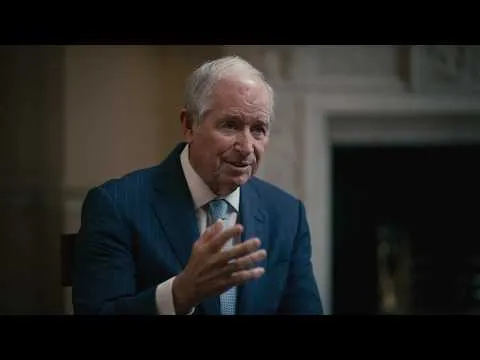
Bloomberg Television revived that account in an October 22, 2026 preview for a forthcoming “Leaders With Francine Lacqua” interview. Schwarzman described his discovery of the AI revolution as accidental. That framing is consistent with an earlier account in which he said Ma, Alibaba’s co-founder and then executive chairman, explained how broadly the technology could transform industries and society. (linkedin.com)
The anecdote is revealing because Schwarzman has not presented himself as a technical inventor. In a 2019 essay, he explicitly situated himself outside engineering, coding and science. His established expertise was judging businesses, allocating capital and building institutions. The AI story therefore became less about mastering algorithms than about recognizing a force that could alter companies, labor, education and international competition. (blackstone.com)
From a conversation to an institutional response
Schwarzman sought technical validation after the encounter. Later accounts identify L. Rafael Reif, then MIT’s president, as an important interlocutor. MIT’s record shows that Schwarzman and Reif spent almost a year discussing the concept that became the MIT Stephen A. Schwarzman College of Computing before its October 2018 announcement. (news.mit.edu)
The structure they backed was broader than a conventional computer-science expansion. Schwarzman’s $350 million foundational gift supported a $1 billion MIT commitment intended to add 50 faculty positions, connect computing with other disciplines, and develop work on the policy and ethical dimensions of AI. MIT described the project as its most significant structural change in decades. (computing.mit.edu)
By 2024, the college had inaugurated its completed headquarters, with capacity for 50 computing research groups. The completed institution provides the clearest evidence that Schwarzman’s AI interest produced more than speeches or forecasts: it helped finance a permanent academic structure combining technical research with questions about human consequences. (news.mit.edu)
A parallel strand developed at Oxford. A £150 million gift announced in 2019 included plans for an Institute for Ethics in AI; subsequent gifts brought Schwarzman’s total support for the humanities centre to £185 million. The institute launched in 2021 and moved into the completed Schwarzman Centre for the Humanities in 2025. Its stated work spans AI safety, governance, law, philosophy and social consequences. (oxford-aiethics.ox.ac.uk)
Blackstone’s AI thesis moved into physical infrastructure
The corporate path was different. An official HKUST citation says Blackstone hired its first data-science team in 2015, the year of Schwarzman’s encounter with Ma, and that he urged portfolio companies to prepare for the technology. That record supports an early organizational response, but it does not demonstrate that every later AI-related transaction followed directly from the bus conversation. (ccss.hkust.edu.hk)
Over the following decade, Blackstone positioned itself around what it calls the “picks and shovels” of AI: data centers, power, data storage and computing capacity rather than primarily consumer-facing AI products. A January 2026 Blackstone paper valued its global data-center portfolio at $110 billion as of June 2025 and described the firm as the world’s largest data-center provider by leased megawatts as of September 30, 2025. Those measurements are Blackstone’s own and should be read with their dates and methodology attached. (blackstone.com)
The strategy has continued through large announced commitments. In July 2025, Blackstone said its managed funds would invest more than $25 billion in Pennsylvania digital and energy infrastructure over an estimated 10-year construction timeline. In May 2026, it announced a joint venture with Google and an initial $5 billion Blackstone equity commitment to offer access to Google’s AI-focused Tensor Processing Units. The venture’s first 500 megawatts of capacity are planned for 2027; the announcement is not evidence that this future capacity has already been built. (blackstone.com)
A personal narrative inside an institutional machine
Schwarzman remains chairman, chief executive and co-founder of a firm reporting nearly $1.4 trillion in assets under management as of September 30, 2026. That scale gives his interpretation of AI consequences beyond personal philanthropy: Blackstone can direct capital toward the land, buildings, energy and specialized hardware services on which AI systems depend. (blackstone.com)
But the portrait requires a distinction between influence and sole authorship. Blackstone’s AI strategy is executed by investment teams, operating executives, portfolio companies and partners; its public announcements often identify other executives, including president and chief operating officer Jon Gray, as the speakers explaining particular investments. Schwarzman’s 2015 story offers a useful origin narrative, not a complete causal history of a multinational firm’s decisions.
What is established is a durable pattern. Faced with a technology he says he initially did not understand, Schwarzman consulted people he regarded as knowledgeable, funded institutions designed to study both capability and risk, and led a firm that placed increasingly large bets on AI’s physical foundations. Whether those bets deliver their promised returns and public benefits remains a question for results, not anecdotes.
Update Record
This profile incorporates Blackstone’s current identification of Schwarzman as chairman, CEO and co-founder and its nearly $1.4 trillion in assets under management as of September 30, 2026. It also includes Bloomberg Television’s October 22 preview, while treating the announced interview as forthcoming because the preview does not establish a completed broadcast date. (blackstone.com)