David Rubenstein’s Politics of the Private Conversation
A reported profile of David Rubenstein’s path from government and private equity to a powerful—but institutionally constrained—role as Washington convener.
File Summary
David Rubenstein has converted a career spanning government, private equity, philanthropy and media into unusual access to American institutions. His new book, “Speaking of America,” makes 19 Library of Congress interviews public. It also illuminates his characteristic method: creating controlled conversations among powerful people while remaining outside elected office and subject to the institutions—and political leaders—that confer his roles.
Standard of Proof
This profile relies on the October 19, 2026 Bloomberg interview description and dated records from the Library of Congress, Carlyle, the Council on Foreign Relations, the National Gallery of Art, Major League Baseball, publishers and the Congressional Research Service. Institutional descriptions are attributed rather than treated as independent judgments. Private motives and undocumented political preferences are excluded.
Established Facts
- Born in Baltimore; graduated from Duke University and the University of Chicago Law School.
- Served in the Carter White House from 1977 to 1981 and co-founded Carlyle in 1987.
- Currently co-chairman of Carlyle and chairman, CEO and principal owner of the Baltimore Orioles.
- Chairs the boards of the Council on Foreign Relations and National Gallery of Art, among other institutions.
- “Speaking of America,” published October 6, 2026, contains 19 interviews from the Library of Congress Congressional Dialogues series. (ir.carlyle.com)
Principal Entities
- David M. Rubenstein — Carlyle co-founder and co-chairman; author, interviewer, philanthropist and institutional board chair
- The Carlyle Group — Global investment firm Rubenstein co-founded in 1987 and formerly led as co-chief executive
- Library of Congress — Host of the Congressional Dialogues series and publishing partner for “Speaking of America”
- Council on Foreign Relations — Foreign-policy institution whose board Rubenstein has chaired since 2017
- National Gallery of Art — Federal cultural institution whose board Rubenstein currently chairs
- Baltimore Orioles — Major League Baseball franchise for which Rubenstein is chairman, CEO and principal owner
- John F. Kennedy Center for the Performing Arts — Institution Rubenstein chaired until its board was reconstituted in February 2025
Chronology
- — Served as chief counsel to the Senate Judiciary Committee’s Subcommittee on Constitutional Amendments.
- — Worked in President Jimmy Carter’s administration as deputy assistant to the president for domestic policy.
- — Co-founded the Carlyle Group, where he later served as co-chief executive and remains co-chairman.
- — The Library of Congress says the Congressional Dialogues series began bringing lawmakers to private, off-the-record receptions featuring Rubenstein’s interviews with authors and experts.
- — Major League Baseball owners approved the sale of a controlling Orioles stake to Rubenstein’s group; the group acquired the remaining shares in August.
- — President Joe Biden awarded Rubenstein the Presidential Medal of Freedom. The following month, a reconstituted Kennedy Center board replaced him as chair with President Donald Trump.
- — “Inside the Owner’s Box” was published September 22, followed by “Speaking of America” on October 6. Bloomberg Television interviewed Rubenstein about the latter on October 19.
Evidence Record
Carlyle’s current corporate biography confirms Rubenstein’s government service, the firm’s 1987 founding and his present position as co-founder and co-chairman. Library of Congress records establish that “Speaking of America” contains 19 interviews from a series begun in 2013. Current institutional pages identify him as chair of the Council on Foreign Relations and National Gallery of Art. A Congressional Research Service report documents the 2025 Kennedy Center transition. (ir.carlyle.com)
Not Established
- The reviewed public record does not establish how the 19 conversations in “Speaking of America” were selected from the longer-running Congressional Dialogues series.
- It does not provide complete records of the off-the-record receptions or show whether participating lawmakers changed their positions because of them.
- The reporting does not establish Rubenstein’s partisan affiliation, voting history or private political preferences.
Open Questions
- Will future volumes disclose more of the Congressional Dialogues archive or explain how conversations are chosen for publication?
- Can a model built on private, invitation-only discussion contribute measurably to public political understanding?
- How will Rubenstein navigate institutions exposed to sharper partisan intervention after his removal from the Kennedy Center board?
- Will ownership of the Orioles alter the balance among his roles as investor, civic benefactor, interviewer and institutional governor?
The File
David Rubenstein occupies a distinctive place in Washington politics: near power, often questioning it, but seldom speaking as a partisan or exercising public authority himself. He worked in Congress and the White House before co-founding the Carlyle Group, then used the wealth, relationships and institutional standing generated by finance to become a chairman, benefactor, interviewer and convener across the capital’s civic establishment.
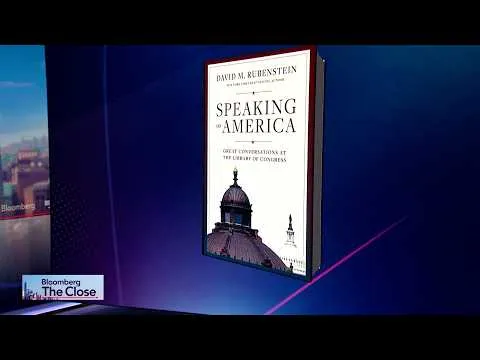
“Speaking of America: Great Conversations at the Library of Congress,” published October 6, 2026, puts that method on display. The book collects 19 conversations from the Congressional Dialogues series, which the Library says has operated since 2013. The format brings lawmakers together for nonpartisan, off-the-record receptions while Rubenstein interviews a prominent author or expert about history, policy or contemporary affairs. The published speakers include Ken Burns, David Grann, Manisha Sinha, Beverly Gage, Michael Beschloss, Siddhartha Mukherjee, William McRaven and Arthur Brooks. (newsroom.loc.gov)
That distinction matters. The volume is not, as the Bloomberg program description could be read to suggest, a collection of Rubenstein interviewing 19 members of Congress. The Library describes authors, historians, journalists and other specialists as the interview subjects; lawmakers formed the invited audience. In his October 19 Bloomberg appearance, Rubenstein argued that the private setting encouraged greater candor than a conventional public event. The available record, however, does not permit an independent assessment of how candid lawmakers were or what effect the meetings had.
The arrangement nevertheless captures Rubenstein’s political position. He does not derive influence from a constituency. He creates forums in which officials and experts meet, then extends selected conversations to television, books and public institutions. The power lies in access, agenda-setting and repetition: deciding whom to question, which subjects to elevate and which exchanges eventually reach a wider audience.
His route to that role began inside government. Carlyle’s biography records that he served as chief counsel to a Senate Judiciary subcommittee in 1975 and 1976 and as a domestic-policy aide in President Jimmy Carter’s White House from 1977 through 1981. After practicing law, he co-founded Carlyle in 1987. He later served as co-chief executive and remains co-founder and co-chairman, although day-to-day executive leadership has passed to others. (ir.carlyle.com)
Finance supplied the platform for a second career in institutional governance. As of October 20, 2026, official records identify Rubenstein as chair of the Council on Foreign Relations and the National Gallery of Art, as well as chairman of the Economic Club of Washington and the University of Chicago’s trustees. The Library identifies him as chair of its James Madison Council. These positions place him at junctions where donors, policymakers, scholars, executives and cultural leaders encounter one another. (cfr.org)
Rubenstein’s public persona links wealth with stewardship of national institutions and historical memory. President Joe Biden awarded him the Presidential Medal of Freedom on January 4, 2025. The recognition followed years of gifts and board service, but it also demonstrated how closely his standing had become connected to institutions shaped, at least partly, by presidential appointments and federal authority. (govinfo.gov)
The limits of that standing became clear weeks later. A Congressional Research Service account said that after President Donald Trump announced plans to replace Kennedy Center trustees, a newly reconstituted board reportedly elected Trump as chair on February 12, 2025, displacing Rubenstein. Rubenstein’s long tenure, philanthropy and relationships did not protect the position when control of the board changed. (congress.gov)
His acquisition of the Baltimore Orioles added another form of civic power. Major League Baseball owners approved the controlling sale to his group on March 27, 2024, and the group acquired the remaining shares that August. The role made Rubenstein accountable not only to fellow trustees or invited audiences but also to employees, fans and a city with expectations for the franchise. His September 2026 book, “Inside the Owner’s Box,” treats sports ownership through interviews with other owners, repeating the conversational formula he has used in finance, leadership and history. (mlb.com)
“Speaking of America” arrives ahead of the 2026 midterm elections with a modest proposition: that historical knowledge and private discussion can create room for reflection in a polarized political system. The Library advances that interpretation in its description of the book. What the record does not yet demonstrate is whether elite conversation can travel beyond the room—or whether Rubenstein’s skill is principally in preserving a space where conversation remains possible. (newsroom.loc.gov)
Update Record
Public records were checked through October 20, 2026. The principal recent development is the October 6 publication of “Speaking of America,” following “Inside the Owner’s Box” on September 22. Current institutional pages continue to list Rubenstein as Carlyle co-chairman and as chair of the Council on Foreign Relations and National Gallery of Art. (newsroom.loc.gov)