Senegal‑sized Antarctic glacier melting faster than thought doubles sea‑level risk
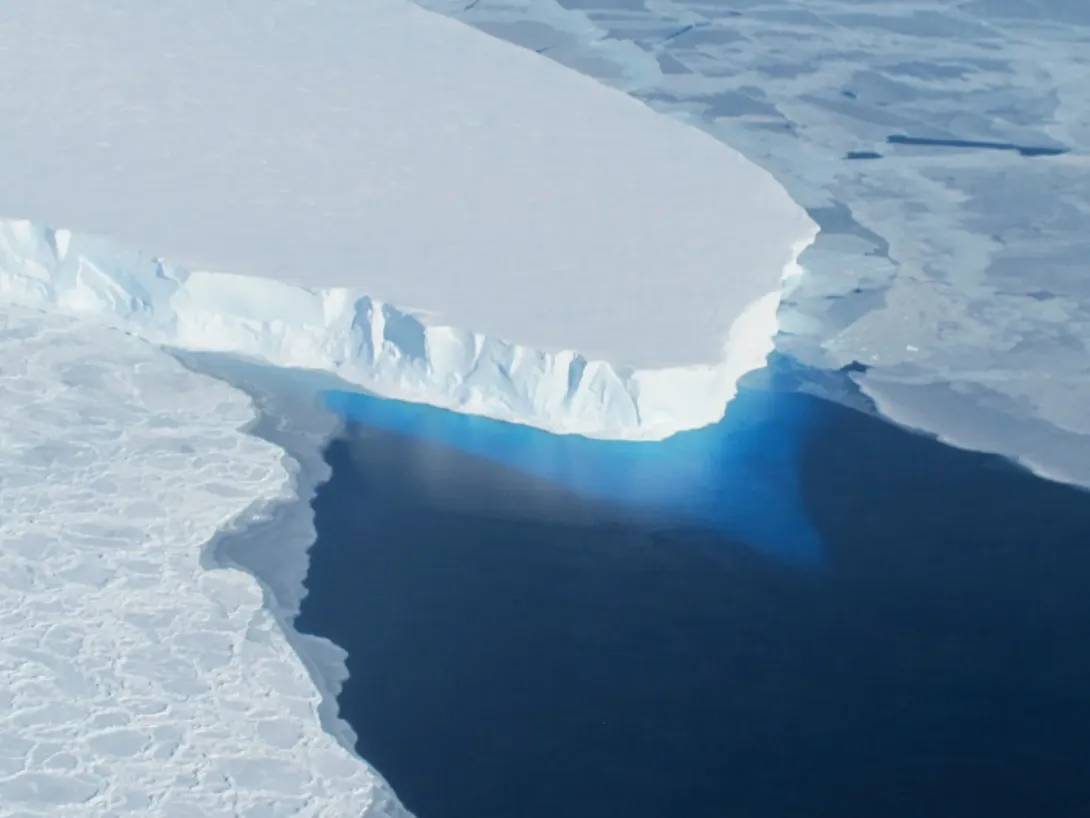
Thwaites, a Senegal‑sized glacier in West Antarctica nicknamed the “Doomsday Glacier,” is melting significantly faster than scientists once thought. New modeling reveals a previously underappreciated mechanism at its grounding zone that doubles its projected sea‑level contribution by 2100—even without further warming.
The Short Answer
Thwaites Glacier, roughly the size of Senegal, is losing ice much more rapidly than expected. Using a new model that treats its grounding line as a broader, fluid “grounding zone,” researchers found warm seawater is being pumped underneath—doubling its projected contribution to sea‑level rise by 2100 to about 1.2 inches (30 mm), even if warming stalls.
Focal Verification
Findings are drawn directly from peer‑reviewed research in Nature Communications and Geophysical Research Letters, and from NASA and UK modeling. Uncertainties persist regarding future warming trajectories and precise timing of ice loss acceleration.
Focal Facts
- Thwaites Glacier is approximately the size of Senegal (≈192,000 km²) and larger than Florida.
- New models treating its grounding line as a tidal ‘grounding zone’ show doubled sea‑level rise impact (≈30 mm by 2100), even without additional warming.
- There is a 60% chance the glacier will unpin from stabilizing bedrock before 2100, accelerating melt.
- British Antarctic Survey models project continued mass loss for at least 150 years, regardless of ocean cooling.
Key Actors
- Thwaites Glacier — glacier losing mass in West Antarctica
- UCLA and NASA’s JPL researchers — authors of the new grounding‑zone melting model
- British Antarctic Survey — conducted modeling projecting long‑term ice loss trends
Focal Timeline
- Study published in Nature Communications reveals rapid basal melting at Thwaites
- British Antarctic Survey projects continued ice loss for at least 150 years
Focal Evidence
The findings are based on a study published in Nature Communications by glaciologists from UCLA and NASA’s Jet Propulsion Laboratory, introducing the concept of a tidal‑pumped grounding zone that accelerates melting beneath Thwaites ([aljazeera.com](https://www.aljazeera.com/news/2026/10/17/senegal-sized-antarctic-glacier-melting-faster-than-thought-why-it-matters?utm_source=openai)). Additionally, a British Antarctic Survey modeling study published in Geophysical Research Letters estimates that even with extreme ocean cooling, Thwaites will continue to lose ice for at least 150 years ([aljazeera.com](https://www.aljazeera.com/news/2026/10/17/senegal-sized-antarctic-glacier-melting-faster-than-thought-why-it-matters?utm_source=openai)).
Focal Outlook
- How soon might the grounding‑zone unpinning begin?
- What mitigation or adaptation measures can coastal cities pursue in light of higher‑than‑expected sea‑level projections?
Full Explanation
Thwaites Glacier—so large it spans roughly the size of Senegal and dwarfs Florida—has long been regarded as a critical driver of future sea‑level rise. But recent findings published in **Nature Communications** reveal it is losing ice far more aggressively than previous models suggested.
Scientists from UCLA and NASA’s Jet Propulsion Laboratory used a refined approach to simulate the glacier’s grounding line: the transition from grounded ice resting on rock to floating ice that forms ice shelves. Traditional models treated this transition as fixed. In contrast, the new analysis conceives a broader “grounding zone,” where tides pump warm seawater farther under the ice, intensifying basal melt. The result: Thwaites may add about **1.2 inches (30 mm)** to global sea levels by 2100—**double** earlier projections, and this is without assuming any future warming increases ([aljazeera.com](https://www.aljazeera.com/news/2026/10/17/senegal-sized-antarctic-glacier-melting-faster-than-thought-why-it-matters?utm_source=openai)).
What makes Thwaites so critical?
Thwaites sits on the Walgreen Coast of Marie Byrd Land in West Antarctica and plays a key role in holding back the vast West Antarctic Ice Sheet. If it destabilizes, it could trigger the collapse of neighboring glaciers, potentially unleashing enough ice melt to raise sea levels by several meters over centuries ([aljazeera.com](https://www.aljazeera.com/news/2026/10/17/senegal-sized-antarctic-glacier-melting-faster-than-thought-why-it-matters?utm_source=openai)). Already, observations indicate Thwaites has shed more than 1,000 billion tonnes of ice since 2000 and is losing about 50 billion tonnes yearly—about 4% of current global sea‑level rise ([aljazeera.com](https://www.aljazeera.com/news/2026/10/17/senegal-sized-antarctic-glacier-melting-faster-than-thought-why-it-matters?utm_source=openai)).
How the new model changes the picture
By representing the grounding line not as a rigid front but as a dynamic zone affected by tidal forcing, the researchers showed that melting is more vigorous than previously assumed. Tidal cycles lift and lower the ice, allowing warm ocean water to infiltrate deeper under the glacier and erode its base from below. This “tidal pumping” leads to faster thinning and promotes ungrounding—undermining the glacier’s stability ([aljazeera.com](https://www.aljazeera.com/news/2026/10/17/senegal-sized-antarctic-glacier-melting-faster-than-thought-why-it-matters?utm_source=openai)).
What do projections show about future loss?
Using this updated framework, the UCLA–NASA team calculates there’s a **60% probability** that Thwaites will unpin from the Mouginot Ridge, a stabilizing bedrock formation, by the end of the century. Once ungrounded, the glacier’s retreat could accelerate sharply ([aljazeera.com](https://www.aljazeera.com/news/2026/10/17/senegal-sized-antarctic-glacier-melting-faster-than-thought-why-it-matters?utm_source=openai)). Separately, a modeling study by the British Antarctic Survey published in **Geophysical Research Letters** (July 2026) finds that even under extreme ocean cooling scenarios, Thwaites will keep losing ice for **at least the next 150 years** ([aljazeera.com](https://www.aljazeera.com/news/2026/10/17/senegal-sized-antarctic-glacier-melting-faster-than-thought-why-it-matters?utm_source=openai)).
Why this matters for coastal risks
Doubling Thwaites’s sea‑level contribution to 30 mm doesn’t by itself spell catastrophe—but when combined with other contributions from Greenland, thermal expansion, and storm surge amplification, it heightens risk for low‑lying communities. Moreover, the unpinning of Thwaites could trigger nonlinear, harder‑to‑predict outcomes, including destabilization of the broader West Antarctic Ice Sheet ([articles.unesco.org](https://articles.unesco.org/sites/default/files/medias/fichiers/2024/11/State%20of%20the%20Cryosphere%20Report%202024.pdf?utm_source=openai)).
These findings underscore a key takeaway: even in the absence of additional greenhouse warming, mechanisms already set in motion beneath Thwaites are enough to drive significant sea‑level rise. That raises the stakes for adaptation planning and emphasizes the need for high‑resolution monitoring of grounding‑zone dynamics.