Special Reports
Makkah Pact Moves From Pledge to Deployment Order
Official decisions have outpaced the available evidence of troops, command rules and legal ratification.
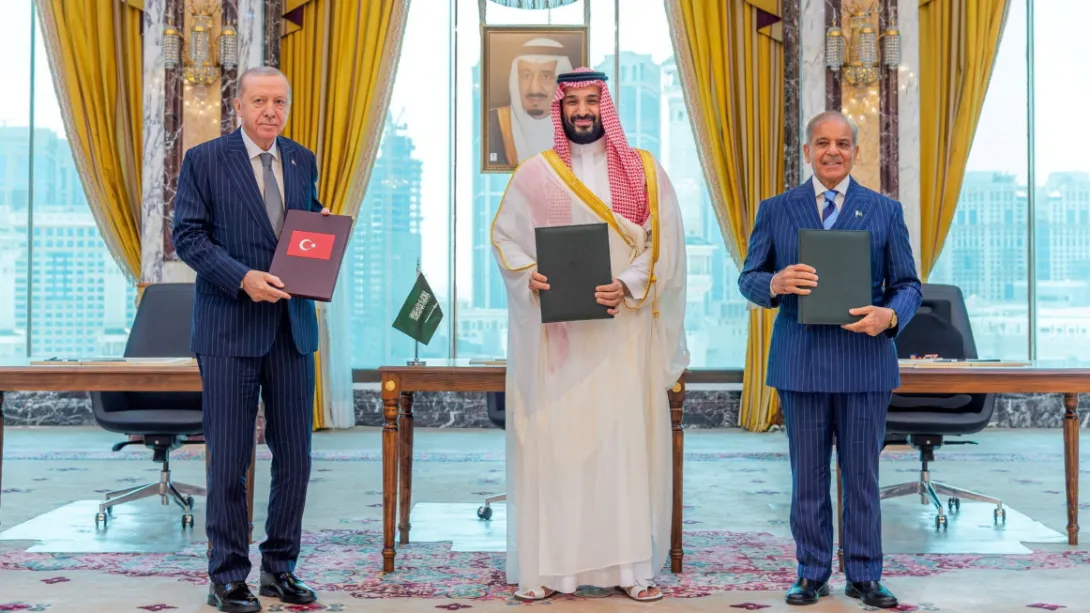
In 59 days, Saudi Arabia, Turkey and Pakistan built institutions and ordered rapid military deployment. The record still does not identify a new integrated force. (mofa.gov.pk)
The public record shows that the Makkah pact has received its first operational order and acquired permanent institutions, but does not yet prove a fresh integrated deployment or automatic collective war commitment. (mofa.gov.pk)
- The Makkah Joint Defence Agreement has moved beyond a political declaration. In the 59 days after its August 7 signing, the three governments established a ministerial and military committee, began creating a Riyadh secretariat and, on October 5, ordered practical implementation and the rapid deployment of agreed forces and capabilities to Saudi Arabia. (mofa.gov.sa)
- That sequence proves an activation decision, not a completed new deployment. Pakistan confirms that substantial forces and resources are already in Saudi Arabia, partly under older arrangements, but neither their composition nor any fresh contribution under the trilateral pact has been disclosed. Turkish assistance was still being discussed in functional terms, including air defence and electronic warfare. (mofa.gov.pk)
- The pact’s legal and operational boundaries remain unresolved. Its full text is unpublished; assistance is request-based and graduated; and Turkey’s parliament had not received the agreement for ratification by October 13. The evidence supports describing Makkah as an emerging defence institution with its first operational order—not yet as a proven alliance guaranteeing automatic war. (mfa.gov.tr)
3 Founding states
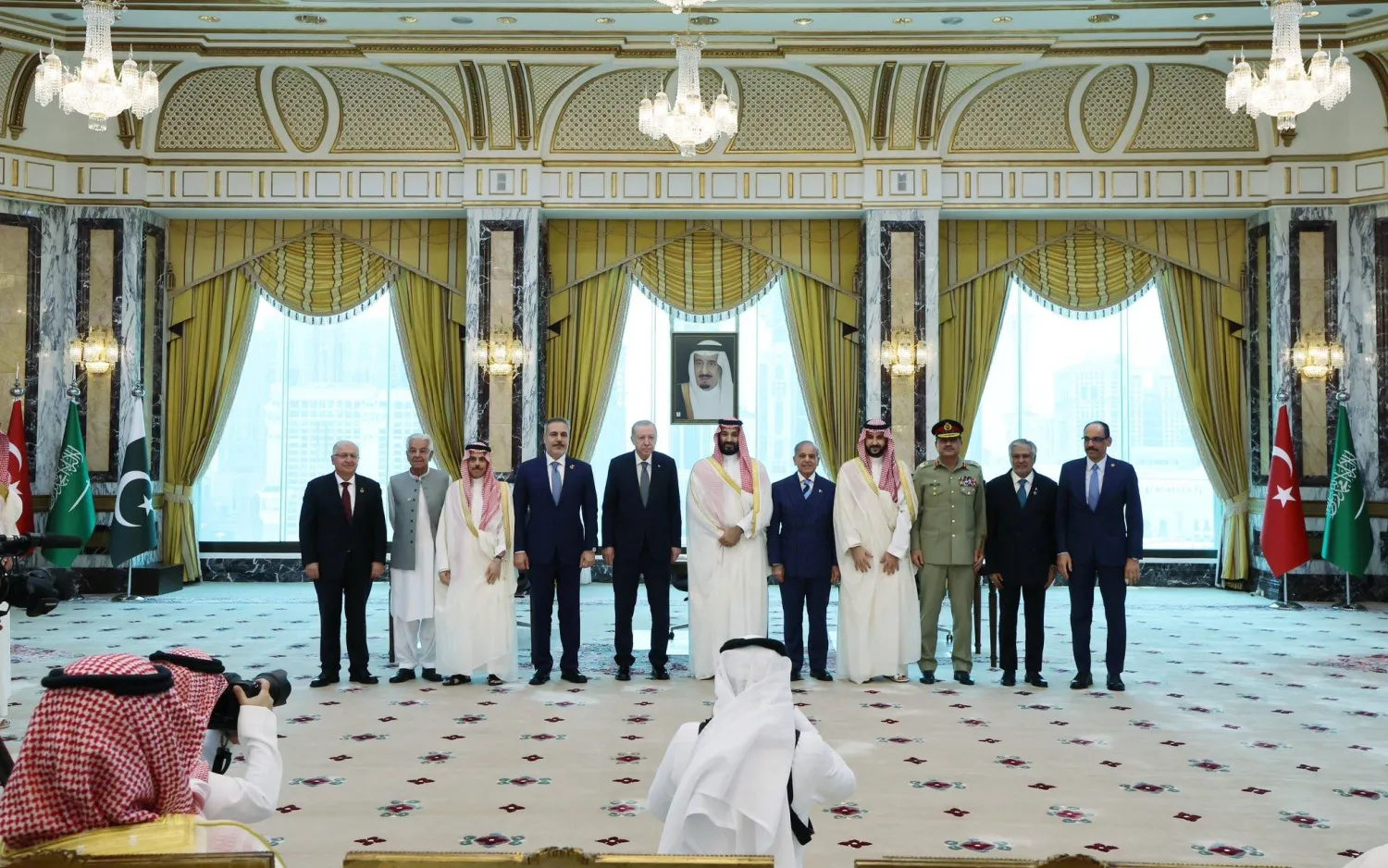
Saudi Arabia, Turkey and Pakistan signed the agreement on August 7, 2026. (mofa.gov.sa)
59 days From signature to implementation order
The committee issued its practical implementation decision on October 5. (mofa.gov.pk)
4 Decisive public milestones
Signing, the first committee meeting, assistance consultations and the implementation order.
3 years First secretary-general’s term
Retired Pakistani Lieutenant General Nauman Mahmood was selected to lead the emerging secretariat. (mofa.gov.pk)
From pledge to deployment order
On October 5, the Makkah Alliance’s Strategic Political and Defence Committee ordered an immediate move to the “practical implementation” of collective-defence commitments. The three governments approved measures to provide agreed military forces and capabilities and to ensure their rapid deployment in Saudi Arabia, subject to approved arrangements and each party’s national legislation. It was the clearest public step yet from diplomatic commitment towards military execution. The decision acquired added urgency as attacks on Saudi airports, cities and energy infrastructure continued into mid-October. (mofa.gov.pk)
That does not mean the record proves that a new joint force arrived. Pakistan says substantial forces and resources were already present under decades of bilateral cooperation, including deployments connected to the 2025 Saudi-Pakistani defence agreement. It has left the scale, location and timing of further mobilisation to the alliance and classified fresh deployment details. Turkey, meanwhile, has discussed possible air-defence, electronic-warfare and technical support without publicly identifying units sent under the trilateral framework. The defensible finding is therefore precise: the agreement received its first formal implementation order, but the public evidence does not yet show the size or composition of any resulting new deployment. (mofa.gov.pk)
The record proves an order to act—not yet the arrival of a new joint force.
| Days since signing | |
|---|---|
| 7 Aug: pact signed | 0 |
| 31 Aug: committee meets | 24 |
| 25 Sep: assistance discussed | 49 |
| 5 Oct: implementation ordered | 59 |
Four documents that built an institution
The August 7 summit statement supplies the core obligation. Saudi Arabia, Turkey and Pakistan declared that an armed attack against one would be regarded as an attack against all three, while promising broader defence cooperation. A Turkish interview the next day defined the mechanism more carefully. Foreign Minister Hakan Fidan called the commitment technically comparable to NATO’s Article 5, but said activation required a request from the state under pressure and decisions by the relevant institutions. Assistance could escalate from intelligence, logistics and ammunition to military units, depending on the threat and the requesting state’s needs. That explanation rules out treating the clause as an automatic declaration of war. (mofa.gov.sa)
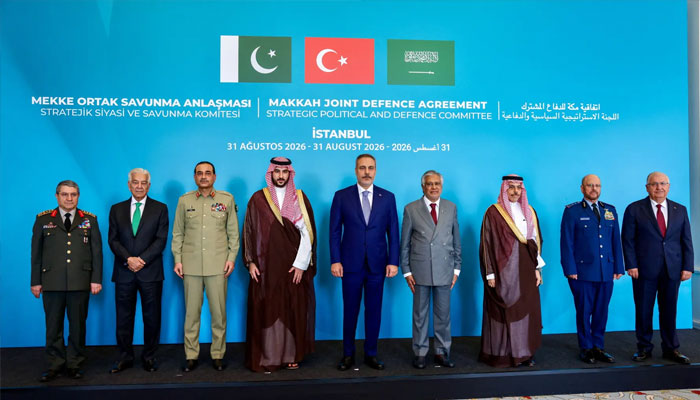
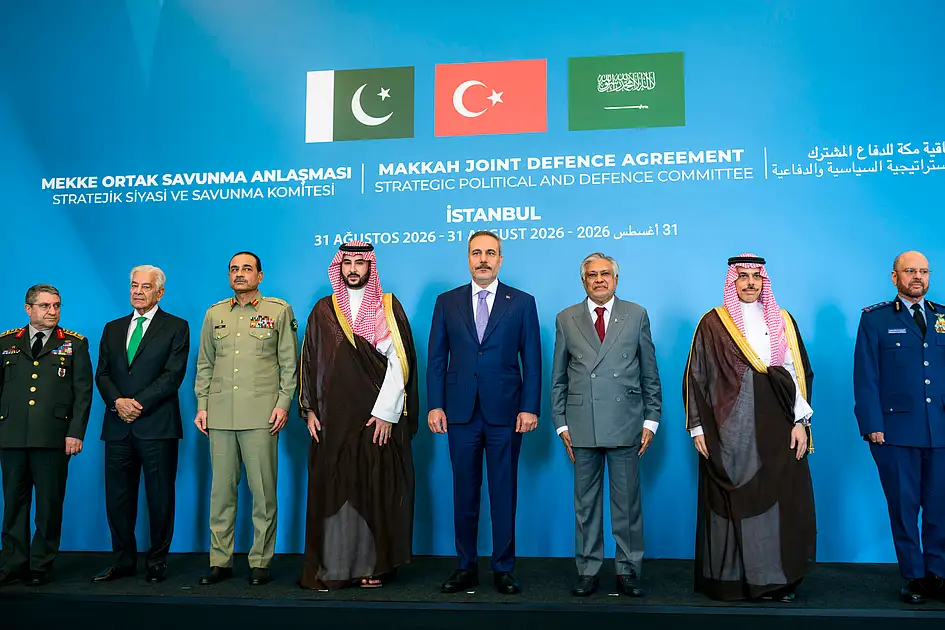
The August 31 Istanbul meeting answered the institutional question. Foreign and defence ministers, together with military chiefs, agreed to deepen institutionalisation, establish a secretariat in Saudi Arabia, give its first three-year term to a Pakistani secretary-general and pursue joint activities in defence production and technology. On September 23, Pakistan nominated retired Lieutenant General Nauman Mahmood; on September 25, the foreign ministers reviewed the secretariat, committees and working groups and discussed an urgent military meeting to examine assistance for Saudi Arabia. These records show that the pact was acquiring offices, personnel and a decision-making process rather than remaining solely a leaders’ communiqué. (mofa.gov.sa)
The October 5 record answered the implementation question. The committee formally selected Mahmood for a three-year term, endorsed the preceding political and military consultations and authorised measures for rapid deployment. Yet the statement omitted the supplying countries, troop numbers, equipment, bases, command relationships and timetable. That evidentiary boundary matters when comparing later developments with the Sumitomo Commerce Global Research assessment: published on September 24 and marked as written on September 17, it correctly treated the pact’s effectiveness as untested, but necessarily preceded both the September 25 assistance discussions and the October 5 order. (mofa.gov.pk)
Each document added a layer: obligation, activation rules, institutions and finally an order to implement.
Three complementary powers, three different calculations
The alliance joins three different sources of power. Saudi Arabia provides the political centre, financing capacity and the territory facing the first declared implementation test. Turkey contributes a large military establishment, NATO experience and an advanced defence-industrial base. Pakistan brings extensive military capacity and a long-standing security relationship with Riyadh; the bilateral Strategic Mutual Defence Agreement signed on September 17, 2025, already declared aggression against either state to be aggression against both. Pakistan’s nuclear status may add political weight to deterrence, but no published Makkah document establishes a shared nuclear doctrine, extended nuclear guarantee or Saudi access to Pakistani nuclear forces. (mofa.gov.pk)
Complementarity does not erase conflicting interests. Ankara says Makkah supplements rather than replaces NATO and Turkey’s other commitments. Pakistan must balance obligations abroad against its own security requirements. Saudi Arabia, meanwhile, maintains relationships—including with India and the United States—that could complicate its response to crises involving another member. The governments also insist that the alliance is defensive and not directed against Iran, Israel or any other named state. Those positions are not inherently inconsistent with the October implementation order: a defensive pact can prepare forces without designating a permanent enemy. But they indicate that future assistance will probably remain threat-specific, politically negotiated and filtered through national procedures rather than centrally automatic. (mfa.gov.tr)
Complementary power does not produce identical threat perceptions.
What the deployment order does not establish
The most consequential missing record is the agreement itself. Public statements disclose its collective-defence principle but not its full clauses, entry-into-force provisions, withdrawal rules, command structure or procedures for authorising force. Turkey’s parliamentary speaker said on September 25 that the agreement had not been submitted to parliament and that international agreements required parliamentary approval to enter into force. Proceedings on October 13 still described the text as not having reached the legislature. This creates an unresolved distinction between preparatory or provisional cooperation and a treaty fully effective in Turkish domestic law—especially because the October 5 decision expressly subjects deployment to national legislation. (tbmm.gov.tr)
Operationally, the evidence is more substantial than it was in September but still incomplete. Pakistan confirms forces and resources in Saudi Arabia and says alliance assets would defend Saudi territory rather than conduct attacks inside Yemen. It also says some additional personnel had previously deployed under the bilateral Saudi-Pakistani agreement. What remains undisclosed is whether October 5 produced fresh trilateral movements, which units are assigned to Makkah, whether Turkish forces or systems have arrived, and who would command them. Mahmood’s October 13 meeting with Pakistan’s president confirmed his appointment, while still describing the Riyadh secretariat as being established. The next test is therefore observable: named units, common exercises, a functioning headquarters, approved deployment mandates, published ratification steps or a documented joint response to another attack. (mofa.gov.pk)
Military secrecy may conceal implementation, but it cannot substitute for public proof of integration.
A narrower definition of operational readiness produces a stronger reading of the alliance. Pakistan already has substantial forces and resources in Saudi Arabia, says those assets may defend Saudi territory, and has made further military capabilities available under the pact. Ankara has publicly discussed air-defence, electronic-warfare and technical assistance. Because force protection and deployment details are commonly classified, the absence of published unit lists does not mean that no practical military coordination is occurring. (mofa.gov.pk)
That argument is persuasive as far as readiness and available capability are concerned, but it does not establish a new trilateral deployment. Pakistan says some additional forces were sent under its earlier bilateral agreement with Saudi Arabia, while decisions about further mobilisation remain with the alliance. On October 14, its military spokesman declined to say whether fresh forces had moved after the October 5 meeting. The public record therefore supports an activated defensive posture, but not yet a documented, integrated deployment by all three members. (arabnews.pk)
The Makkah pact is now more than a declaration. Its members have created a political-military committee, designated a permanent secretariat, appointed its first leader and authorised practical collective-defence measures. Pakistan’s existing presence in Saudi Arabia gives the framework immediately available capacity, even before any fresh movement is publicly confirmed. (mofa.gov.pk)
It is nevertheless less than a demonstrated integrated alliance. The treaty text remains unpublished, Turkey’s ratification process is incomplete, operational command is undisclosed and no public evidence identifies a new three-country force deployed because of the October order. Its credibility should now be judged through verifiable actions—units assigned, mandates approved, headquarters activated and responses delivered—not through the collective-defence formula alone. (tbmm.gov.tr)
Confidence: High confidence in the institutional and decision sequence; moderate confidence in the operational assessment because deployment details remain classified or undisclosed.