The lunar reactor race is really a contest to set the Moon’s operating infrastructure
The United States, Russia and China are pursuing lunar fission power because reliable electricity could determine where sustained exploration is practical—and who shapes the infrastructure around it.
Overview
The emerging lunar reactor contest is less a race to plant the first nuclear device than a competition to make long-duration operations feasible near the Moon’s south pole. Fission could supply steady electricity where darkness, extreme cold and difficult terrain constrain solar generation. That would give the operator practical influence over base locations, power standards and access to nearby resources. But the programs are not equivalent in maturity, and none has yet demonstrated a complete reactor, landing system and autonomous deployment chain on the Moon.
Facts
- A December 18, 2025 US executive order directed development of a lunar surface reactor ready for launch by 2030. (whitehouse.gov)
- An April 14, 2026 US policy memorandum specified at least 20 kilowatts of electrical output for at least five years on the lunar surface; at least one design should be extensible to 100 kilowatts. (whitehouse.gov)
- An October 2026 procurement notice said NASA intended to issue the final Space Power and Reactor Capabilities request for proposals around November 20, 2026. (sam.gov)
- China’s official plan calls for a basic International Lunar Research Station near the lunar south pole by 2035. CNSA and Roscosmos established their cooperation framework in 2021. (english.www.gov.cn)
- Russia has set a goal of creating a lunar power station based on a nuclear unit by 2036, involving Roscosmos, Rosatom and the Kurchatov Institute. (en.russia.ru)
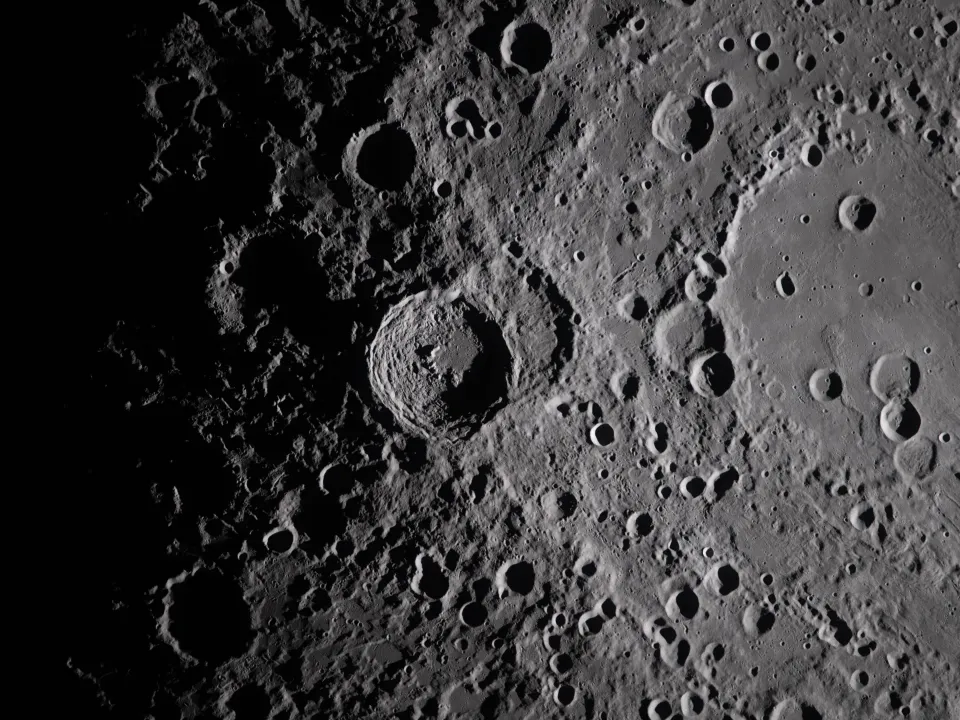
The strategic value of a lunar reactor begins with an engineering constraint: sustained activity requires electricity when sunlight is unavailable or unreliable. The lunar south pole contains elevated areas with long periods of illumination, but its lighting varies sharply with terrain, while permanently shadowed craters receive no sunlight and can reach extreme temperatures. Those craters are scientifically important because observations indicate that some contain water ice, although its concentration and accessibility remain uncertain. (nasa.gov)
Fission does not replace every solar panel. Its advantage is firm power: electricity that can support communications, thermal control, scientific instruments and eventually resource-processing equipment without depending on illumination. A reactor could therefore turn intermittent expeditions into a more continuous operating system. That is the causal link between nuclear power and strategic influence. The actor able to deliver dependable energy can design habitats, vehicles and industrial equipment around its system and invite partners to adopt compatible interfaces.
The United States currently has the clearest publicly documented development pathway. Its April 2026 national initiative directs NASA to run competing reactor designs, reach preliminary design review and conduct hardware ground tests. The baseline is a mid-power system producing at least 20 kilowatts for five years on the lunar surface, with a pathway toward higher output. (whitehouse.gov) NASA and the Department of Energy renewed their partnership in October, while the latest procurement notice placed the program before a planned final solicitation rather than at flight-hardware completion. (nasa.gov) The 2030 date is therefore a policy and acquisition target, not evidence that a reactor or lander is ready.
China and Russia are organizing around a different architecture. Their International Lunar Research Station is intended as a long-duration research complex, with China placing its basic south-polar station around 2035 and Russia targeting a nuclear-based power station by 2036. (english.www.gov.cn) Their announcements establish strategic intent, but the public record provides less detail about current reactor requirements, testing milestones and deployment integration than the US documents do. Calling all three countries participants in one synchronized race therefore overstates the evidence.
The stronger judgment is that they are competing to define the conditions of sustained lunar presence. A functioning reactor would not confer sovereignty: international law bars appropriation of the Moon. But equipment locations, cables, landing corridors and legitimate safety requirements could shape how nearby operations are coordinated. That may create operational leverage without creating legal ownership.
Two alternatives temper the nuclear narrative. First, solar arrays, storage and radioisotope systems may cover many early missions, particularly at favorable illuminated sites; NASA is developing several such technologies alongside fission. (nasa.gov) Second, accessible ice has not yet been mapped well enough to prove that large-scale extraction will be economical. Reactors could initially power science and survival rather than mining. The race is consequently about preserving future options, not exploiting a proven lunar economy.
Context / evidence
The legal baseline permits peaceful nuclear power but constrains how it is used. The Outer Space Treaty prohibits national appropriation, requires due regard for other states’ interests and calls for avoidance of harmful contamination. (unoosa.org) The Artemis Accords describe temporary safety zones as notification and coordination mechanisms rather than territorial claims. (nasa.gov) However, no operating experience exists for managing multiple national reactors, resource sites and crews in close proximity on the Moon. Public records also do not establish the final Russian reactor specifications or demonstrate that any announced schedule is technically achievable.
Impact
No lunar reactor has yet produced an observed economic or geopolitical effect on the surface. The immediate impact is institutional: governments are aligning space agencies, nuclear laboratories, contractors and mission architectures around continuous power. For explorers, successful fission could reduce dependence on large storage systems and expand operations into dark or cold terrain. The corresponding risks include launch accidents, reactor failure, contamination and interference with nearby science or missions. International safety guidance treats the spacecraft, launch system, mission design and reactor as one integrated safety case, rather than evaluating the reactor alone. (iaea.org)
Outlook
The strongest near-term indicators will be procurement awards, completed preliminary designs, ground tests, fuel availability and confirmed lunar delivery systems—not political deadlines alone. NASA’s anticipated final solicitation will show whether its 2030 objective has an executable commercial path. For Russia and China, evidence would include disclosed reactor requirements, funded hardware contracts and integration with planned ILRS missions. A serious multilateral process on reactor separation, accident notification, decommissioning and interference would reduce the risk that incompatible national practices become entrenched before hardware arrives. Until those indicators appear, the contest remains an infrastructure strategy supported by early development rather than an imminent deployment race.