Tehran talks create a regional channel as Houthi attacks continue
The four-way Tehran channel is a diplomatic opening, but its value depends on whether continued dialogue produces verifiable restraint across interconnected conflicts.
Overview
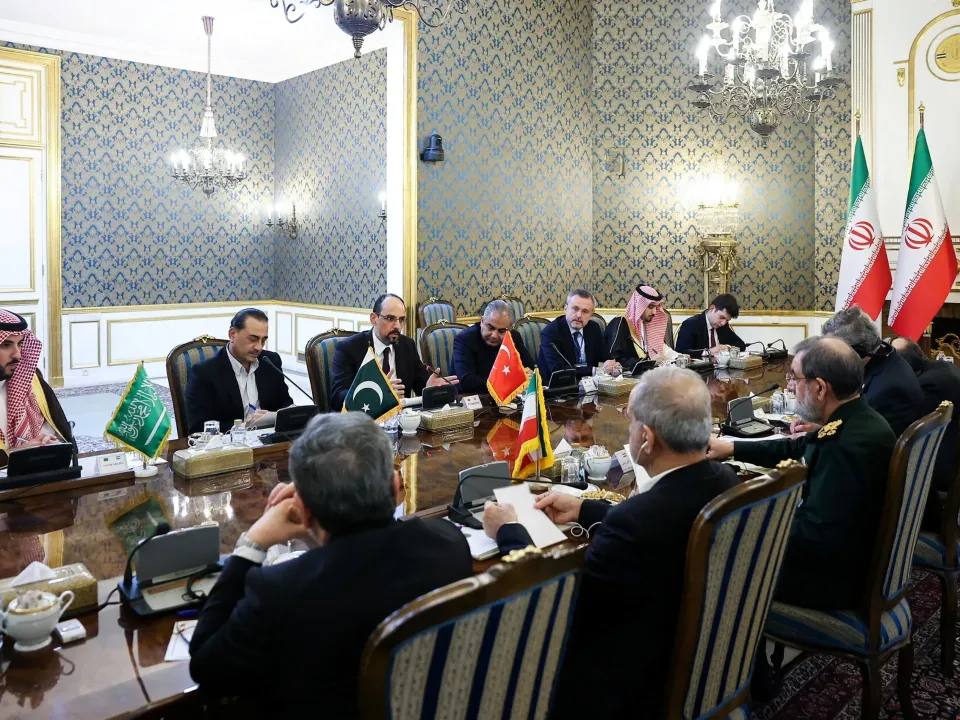
The October 26 Tehran meeting created a useful channel between Iran and the three members of the Mecca Joint Defense Agreement, but it did not establish a de-escalation accord. Its significance lies in bringing deterrence and mediation into the same room: Saudi Arabia, Pakistan and Türkiye can coordinate defenses while pressing Iran over regional escalation. The immediate test is narrower than a comprehensive settlement—whether the participants can reduce Houthi attacks, protect civilian infrastructure and prevent the Yemen front from feeding a broader confrontation.
Facts
- Iran hosted Saudi Defense Minister Khalid bin Salman, Pakistan’s Field Marshal Asim Munir and Turkish intelligence chief Ibrahim Kalin in Tehran on October 26. Iran’s delegation included Supreme National Security Council Secretary Mohsen Rezaei and Foreign Minister Abbas Araghchi. (presstv.co.uk)
- The four governments agreed to continue dialogue and strengthen cooperation, including on regional peace and security. The published statement did not specify the date or location of another meeting. (presstv.co.uk)
- Türkiye, Saudi Arabia and Pakistan signed the Mecca Joint Defense Agreement on August 7. A Turkish parliamentary committee approved it on October 27, but a full assembly vote had not been scheduled in that report. (apnews.com)
- Fighting continued after the meeting. On October 30, a Saudi-backed Yemeni military spokesman reported ballistic-missile strikes on Aden, while the Saudi-led coalition reported intercepting Houthi drones near Mecca and Medina. The Houthis denied targeting those areas. (apnews.com)
The Tehran meeting matters less for what its brief statement promised than for the political structure it assembled. Saudi Arabia arrived as the principal target of the current Houthi campaign. Pakistan and Türkiye arrived as Riyadh’s defense partners but also as governments positioned to communicate with Iran. Tehran, meanwhile, was asked to engage with states strengthening collective defenses against an armed movement aligned with it.
That combination creates a potential mechanism for de-escalation. Saudi Arabia, Pakistan and Türkiye can communicate the military and political costs of continued attacks directly to Iranian officials while offering an alternative to uncontrolled escalation: regional consultations, political engagement and clearer limits around each actor’s conduct. Iran gains a channel to address the security concerns of the defense pact’s members without formally joining or endorsing their alliance.
The available record does not show that this mechanism has yet produced restraint. The four-party statement committed the participants only to continued dialogue and stronger cooperation. It did not publicly establish commitments on Houthi attacks, Iranian assistance to the movement, Saudi-led operations in Yemen or the implementation of the defense pact. Nor did it announce when negotiations would resume. (presstv.co.uk)
Continued violence underscores that distinction. Four days after the meeting, a Saudi-backed Yemeni spokesman attributed ballistic-missile attacks on Aden to the Houthis. The Saudi-led coalition separately said it intercepted drones near Mecca and Medina, an account disputed by the Houthis. These reports do not prove that the Tehran talks failed: negotiations may initially operate as crisis communication rather than generate an immediate ceasefire. They do show that the meeting had not produced an observable halt in hostilities by October 30. (apnews.com)
A credible alternative interpretation is that the sparse statement conceals substantive private exchanges. Security officials rather than ceremonial delegations led the meeting, and subsequent reporting said Saudi, Turkish and Pakistani representatives reinforced wider mediation aimed at preventing renewed US-Iran fighting. Qatar also continued its own contacts with Tehran. (apnews.com) Quiet diplomacy can be valuable when public concessions would carry domestic or strategic costs.
Even so, access should not be confused with influence. The public record does not establish that Iran agreed to restrain the Houthis, that the Houthis accepted a negotiating channel or that the defense pact members reached a common response to future attacks. Iran’s relationship with the movement gives Tehran relevance, but not necessarily command over its operational decisions.
The bounded judgment is therefore that Tehran produced diplomatic infrastructure, not a breakthrough. Its value will depend on whether the participants convert overlapping channels into specific arrangements: communications during attacks, agreed protections for civilian sites, political contact with Houthi representatives and a separation of defensive assistance to Saudi Arabia from an expanded intervention inside Yemen.
Context / evidence
The Tehran meeting followed an October 23 gathering in Istanbul where ministers from Saudi Arabia, Pakistan, Türkiye, Egypt and four European governments discussed the Iran conflict, Houthi attacks, maritime security and regional de-escalation. (auswaertiges-amt.de) The defense pact gives the diplomatic effort a harder edge: its provisions treat an armed attack on one member as an attack on all three and provide for intelligence sharing, military cooperation and joint weapons production. Turkish officials nevertheless described the pact as defensive and ruled out sending troops to fight the Houthis in Yemen. (apnews.com)
Impact
For civilians, the consequences remain immediate even while diplomatic results are uncertain. The United Nations said displacement in Yemen had surpassed 281,000 as the conflict continued spreading, while the October 30 attack reports involved Aden’s airport, a government facility and areas near Saudi Arabia’s holy cities. (apnews.com) For governments, the talks may reduce the risk that an attack automatically triggers wider retaliation by providing direct communication. Conversely, an undefined relationship between diplomacy and collective defense could increase miscalculation if Iran, the Houthis or pact members interpret military preparations differently. No reduction in that risk has yet been demonstrated.
Outlook
The next phase can be assessed through observable steps rather than further general declarations. Key indicators include a scheduled follow-up meeting, a standing contact mechanism, direct or Iranian-facilitated engagement with the Houthis, and any sustained decline in attacks on Saudi or Yemeni civilian infrastructure. Türkiye’s full parliamentary vote and any defined military assistance to Saudi Arabia will show how deterrence develops alongside diplomacy. Continued Qatari mediation with Iran provides another indicator: coordination between that track and the Tehran group would suggest an emerging regional process, while disconnected initiatives and persistent attacks would indicate continued crisis management without an enforceable settlement. (apnews.com)