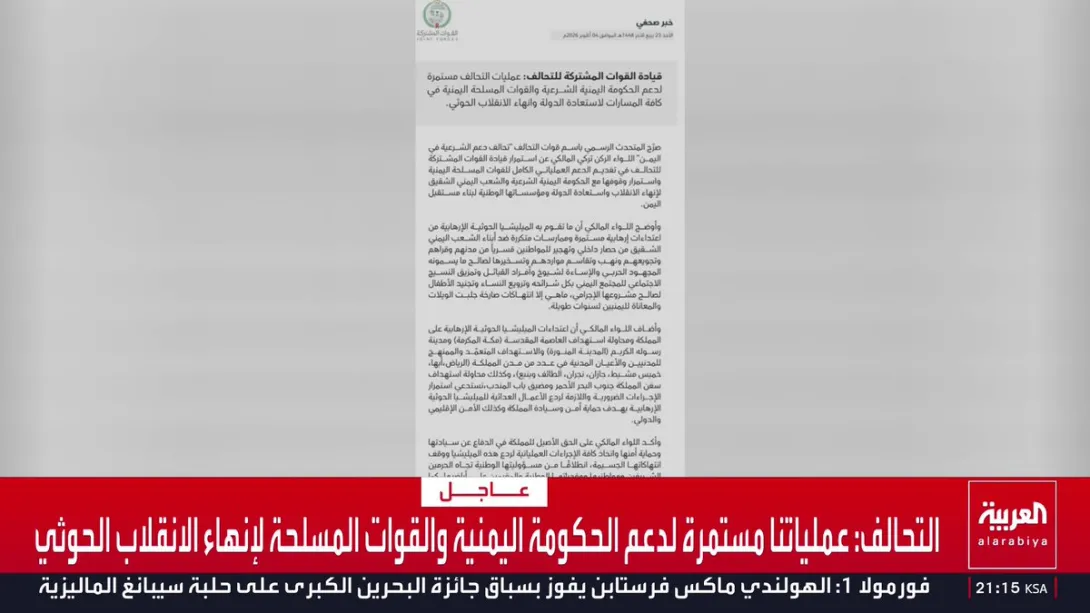
Saudi-led Coalition Intensifies Military Actions against Houthi Forces
The Saudi-led coalition's military actions against Houthi forces in Yemen highlight a complex conflict with historical, regional, and humanitarian implications.
Focal Argument
The Saudi-led coalition's military response to Houthi aggression underscores the persistent geopolitical and humanitarian complexities of the Yemen conflict, necessitating both immediate containment strategies and longer-term resolutions for peace and stability.
Focal Facts
- The Houthi movement, officially known as Ansar Allah, began in northern Yemen and gained significant power during the Yemeni civil war.
- Saudi Arabia leads a coalition supporting the Yemeni government against the Houthi rebels, who are accused of launching attacks on Saudi territories.
- The conflict has resulted in a severe humanitarian crisis, with millions of Yemenis facing starvation and displacement.
Context & Timeline
The Saudi-led coalition has been engaged in the Yemeni conflict since 2015, responding to the Houthi movement's capture of the capital, Sanaa. The coalition’s military operations are part of broader regional power dynamics involving Iran and Gulf states.
Saudi-led Coalition's Strategic Objectives
The Saudi-led coalition's recent statement concerns the necessity of military action in response to what they describe as hostile activities by the Houthi forces. This action underscores the coalition’s strategic objective to support the Yemeni government in reclaiming power from the Houthi rebels, who they accuse of destabilizing the region and orchestrating aggression against Saudi territories. The coalition's operations aim to deter Houthi advancements and diminish their capacity to project power regionally.
Geopolitical Intricacies and Historical Context
Historically, Yemen has been a battleground for competing regional powers. The Houthi movement, part of the Zaidi Shia community, rose to prominence during the Arab Spring, positioning itself against both foreign and domestic adversaries. Their gain of control in 2014 escalated into a multifaceted civil war, drawing in Saudi Arabia and its allies under the premise of protecting regional stability and countering Iranian influence, as Iran has been accused of supplying arms and support to the Houthi.
The coalition's intent to support the Yemeni government articulates a broader geostrategic goal of counterbalancing Iranian influence, perceived through the growing power of the Houthis in the Southern Arabian Peninsula, which could threaten the balance of power in the Gulf. Within this context, the coalition’s military actions can be seen as an extension of regional geopolitical rivalries.
Humanitarian Costs and International Reactions
The military actions have exacerbated Yemen’s humanitarian crisis. According to the United Nations, Yemen faces one of the world’s worst humanitarian situations, with millions affected by famine, lack of medical supplies, and displacement. The coalition's airstrikes have been criticized for contributing to this crisis, despite their official stance that they are targeting only Houthi military installations.
International bodies and human rights organizations advocate for a ceasefire and a pivot toward diplomatic dialogues. The tension between military objectives and humanitarian obligations has drawn global scrutiny, with calls for stricter humanitarian law adherence and greater efforts in peace negotiations.
Evaluating the Counterargument
Critics of the coalition argue that continued military aggression may further entrench hostilities rather than resolving them. Suggestions for leveraging diplomatic strategies, emphasizing negotiation over military force, convey a credible countercase. Diplomatic engagement, potentially including broader talks involving Iran, Saudi Arabia, and Yemeni factions, might address underlying grievances and foster conditions conducive to peace.
Evidence such as sustained communication channels between conflicting parties, reduction in violent clashes, and increased humanitarian access would validate the effectiveness of diplomatic solutions over military ones. However, the entrenched positions of the Houthi leadership and the coalition’s strategic commitments present substantial obstacles to shifting entirely to diplomatic engagements.
Conclusion: Pathways to Stability
The coalition's ongoing military strategies against Houthi aggression in Yemen reveal the deeply ingrained regional and international complexities affecting the conflict. While immediate military actions target strategic stability for the coalition and allies, the humanitarian toll and potential for unintended escalation call for a renewed contemplation of strategies that prioritize durable peace and humanitarian concerns.
Achieving tangible progress requires coordinated international pressure to facilitate ceasefires, coupled with humanitarian efforts and inclusive political dialogues that consider all factions within Yemen. The dynamics introduced by advancing these talks could reveal new avenues for stabilizing a region long marked by conflict and human suffering.
Room for Disagreement
The coalition's military strategy could be seen as exacerbating the conflict and humanitarian crisis, suggesting a shift towards diplomatic engagement might yield better results.
Focal Impact
The continued military engagement risks extending the humanitarian crisis and regional instability. Efforts toward mediated conflict resolution and humanitarian aid are critical for sustainable peace.
Focal Outlook
International mediation and increased humanitarian aid could foster progress towards peace. Monitoring the coalition's operations and diplomacy will be essential.