Russell Brand’s conviction exposes how celebrity media can turn transgression into protection
The conviction shifts scrutiny from Russell Brand’s cultivated persona to the institutions that repeatedly converted provocation into cultural value.
Overview
Russell Brand’s crimes were his own, but the record supports a narrower institutional judgment: media companies helped create the fame, access and exceptional status that increased his power while making troubling conduct easier to interpret as part of a profitable persona. His conviction does not prove that executives knew about every offence. It does show the danger of systems in which commercially valuable talent receives unusual latitude, workplace concerns remain fragmented and transgression itself becomes entertainment. (judiciary.uk)
Facts
- A Southwark Crown Court jury convicted Brand on November 5, 2026, of one count of rape and three counts of sexual assault involving four women. He was acquitted of three other charges. (cps.gov.uk)
- On November 9, Mr Justice Bennathan sentenced Brand to 10 years and six months in prison for offences committed between 2004 and 2009. (judiciary.uk)
- The Metropolitan Police said investigators spoke to more than 100 witnesses, took more than 400 statements and reviewed over 1,400 documents. (news.met.police.uk)
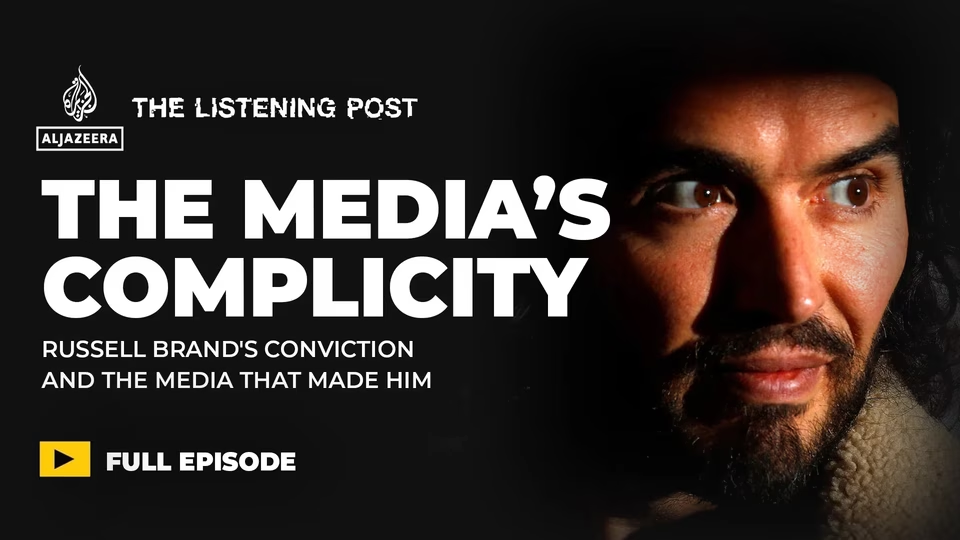
- Al Jazeera’s Listening Post programme, published November 16, examines how influential media institutions supplied Brand with platforms, credibility and audiences. (aljazeera.com)
The phrase “the media that made him” requires care. Broadcasters did not make Brand commit rape or sexual assault, and institutional failure should not dilute his individual responsibility. What the media made was the public asset: a celebrity whose commercial appeal rested partly on behaving as though ordinary boundaries did not apply.
That distinction explains the mechanism connecting cultural production to institutional risk. Brand’s sexually aggressive, unpredictable and rule-breaking image was not merely tolerated around his work; it was central to the work being sold. Broadcasters received attention and audiences. Newspapers received copy. Brand received visibility, authority and access. Behaviour that might have prompted scrutiny in another employee could consequently be absorbed into an established character: the outrageous comedian doing what audiences expected.
The criminal record shows why that status mattered. The sentencing judge found that Brand was becoming famous when his offending began and said his status protected him until journalists published allegations in 2023. The judge also described associates failing to intervene during two assaults, although he did not find that they knew in advance what Brand intended. (judiciary.uk) This is evidence of social permission operating around celebrity, not proof of a coordinated institutional cover-up.
Institutional fragmentation strengthened that permission. Television production distributes responsibility among broadcasters, commissioning departments, independent producers, managers and temporary crews. A concern known in one part of that network may never reach the people deciding whether to hire or promote a performer. Channel 4’s own investigation illustrates the problem: it found that a 2009 allegation was not properly investigated or escalated, yet also found no evidence that commissioning staff knew the specific allegations contained in the 2023 documentary. (assets-corporate.channel4.com) Both findings can be true. Information can fail without an organisation collectively deciding to suppress it.
A credible alternative explanation is that Brand’s employers lacked sufficiently concrete information to act. Channel 4 found uncorroborated recollections that serious rumours circulated around commissioning in 2018, but no written evidence establishing that decision-makers possessed specific allegations when he was cast in a programme recorded that year. (assets-corporate.channel4.com) That limits claims that executives knowingly continued to platform an identified offender.
It does not, however, remove the wider cultural question. An institution need not know about a crime to recognise a workplace environment in which humiliation, sexualised conduct or intimidation is being reframed as creative spontaneity. The BBC’s review found that some people believed Brand’s influence meant he would get his way, while Channel 4 acknowledged that one serious complaint disappeared inside its management structure. (apnews.com)
The bounded conclusion is therefore not that media institutions caused or knowingly concealed every offence. It is that celebrity production created an asymmetry: Brand’s persona was visible and valuable, while objections from less powerful people were dispersed, informal or career-threatening. The same institutions that magnified his transgression were poorly configured to recognise when performance, workplace misconduct and criminal behaviour occupied the same continuum.
Context / evidence
The strongest institutional evidence is specific rather than sweeping. Channel 4’s review examined 111,984 emails, 333 archived files and approaches to 88 current or former employees. It found no evidence that staff knew the particular allegations later broadcast by Dispatches, but concluded that a serious 2009 complaint was neither investigated nor passed up the management chain as procedures required. (assets-corporate.channel4.com) A separate BBC review considered eight complaints and found that Brand’s status contributed to employees’ reluctance to speak, according to the BBC’s findings reported by AP. (apnews.com)
Impact
The observed consequences extend beyond institutional embarrassment. The sentencing record describes lasting harm to the four women, including trauma, damaged trust, disruption to work and continuing distress when Brand appeared in media. (judiciary.uk) For cultural organisations, the case makes safeguarding part of commissioning and production rather than a narrow human-resources function. The plausible broader effect is greater scrutiny of how broadcasters manage powerful freelance talent, entourages and independent suppliers. Yet stronger procedures cannot be assumed to have worked merely because they were introduced; the public record does not establish how consistently current systems detect or resolve comparable concerns before publication or police involvement.
Outlook
The test is whether the reckoning produces mechanisms that work before a public scandal. Relevant indicators include whether complaints about prominent talent reach decision-makers across commissioning and production boundaries; whether freelancers can report concerns without jeopardising employment; and whether repeated low-level warnings are assessed together rather than treated as isolated incidents. Channel 4 has proposed stronger behaviour codes, escalation routes and engagement with an independent creative-industries standards body. (assets-corporate.channel4.com) Those measures would gain credibility through transparent reporting on their use and outcomes, without disclosing complainants’ identities. Further criminal proceedings or newly documented institutional knowledge could materially change the assessment.