Preliminary Brewers-Rays World Series ratings point to scheduling drag, not a small-market collapse
The 2026 Fall Classic lost viewers against recent Dodgers-led series, but its sharpest decline coincided with an NFL clash and a lopsided game—not simply the teams’ market size.
Overview
The preliminary television record does not support describing the Milwaukee Brewers–Tampa Bay Rays World Series as an across-the-board audience failure. The five-game series was projected to average roughly 11.8 million viewers, behind the previous two Dodgers-led editions but ahead of the other World Series played since 2019. The stronger explanation for its uneven performance is a combination of limited national drawing power, game competitiveness and scheduling. Its Monday low illustrates baseball’s vulnerability to the NFL; the subsequent rebound shows that the small-market matchup still attracted a substantial audience when conditions improved. (sportsmediawatch.com)
Facts
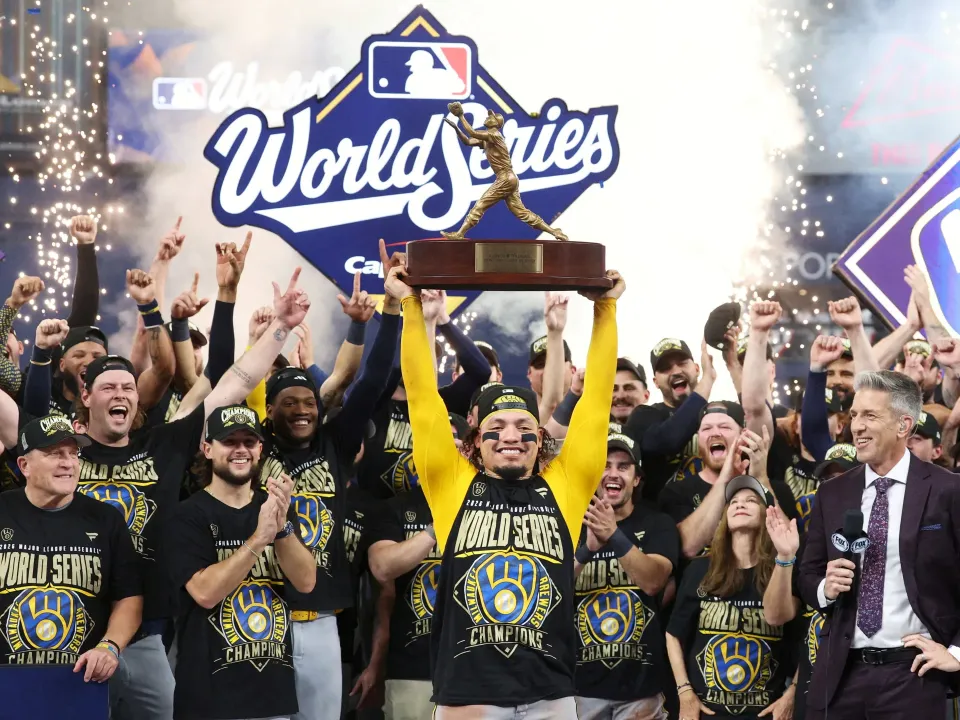
- Milwaukee defeated Tampa Bay four games to one, clinching its first World Series championship with a 4-1 victory on October 28. (mlb.com)
- Game 1 averaged 12.26 million viewers across Fox, Fox Deportes and Univision; Game 2 averaged 10.85 million across Fox and Fox Deportes. (sportsmediawatch.com)
- The Brewers’ 10-1 Game 3 victory averaged 8.33 million viewers while competing against an NFL broadcast averaging about 18.8 million. (frontofficesports.com)
- Game 4 rebounded to 13.48 million viewers, while Fox projected 14.22 million for Milwaukee’s championship-clinching Game 5. (sportsmediawatch.com)
- Tampa–St. Petersburg and Milwaukee represented approximately 3.2 million television homes combined, the smallest World Series market footprint in two decades. (sportsmediawatch.com)
The Brewers–Rays matchup began with an apparent structural handicap: its home markets contained far fewer television households than recent World Series pairings. That reduced the number of automatic local viewers and removed the ratings lift supplied by clubs such as the Los Angeles Dodgers and New York Yankees. Market size therefore helps explain why the 2026 average was lower than in 2024 and 2025.
It does not, however, explain the series’ full trajectory. Friday’s opener drew 12.26 million viewers and Saturday’s second game drew 10.85 million. Those totals were below the corresponding 2025 broadcasts, but the declines were comparatively limited given the large difference in market reach. Both games were close Milwaukee victories, providing neutral viewers with competitive contests and allowing the series to begin without direct NFL competition. (sportsmediawatch.com)
The audience broke sharply in Game 3. Milwaukee scored eight runs in one inning during a 10-1 rout, while the broadcast competed directly with Dallas Cowboys–Philadelphia Eagles on Monday Night Football. The baseball audience fell to 8.33 million, one of the smallest recorded for a World Series game, while the NFL game attracted about 18.8 million. (frontofficesports.com)
That juxtaposition supplies the strongest evidence for the causal judgment. A small-market matchup established a lower potential ceiling, but the combination of an uncompetitive score and America’s most powerful sports television property produced the exceptional low. Neither factor can be isolated precisely from the public figures, yet the next two games provide a useful natural comparison.
With no comparable football broadcast on Tuesday, Game 4 rose to 13.48 million viewers as Tampa Bay won in 12 innings and prevented a sweep. Fox then projected 14.22 million for Wednesday’s Game 5, when Milwaukee clinched the championship. Those were the series’ two largest audiences despite featuring the same clubs and the same limited home-market base. (sportsmediawatch.com)
The rebound weakens the proposition that viewers broadly rejected Brewers–Rays because of the participants. It instead points to a layered mechanism: famous teams and larger markets raise the starting audience, while scheduling, competitive tension and the possibility of a decisive result determine how much of that audience remains or grows. MLB’s Friday World Series start, adopted to reduce football overlap, limited direct NFL competition to Monday. In 2026, that protected four of the five games but left Game 3 exposed. (frontofficesports.com)
The series still revealed a constraint for baseball. Unlike the NFL’s championship events, the World Series cannot yet rely on matchup-independent national demand at the same scale. But an average near 11.8 million—projected as the strongest since 2019 apart from the previous two editions—does not establish a general collapse. It demonstrates that baseball’s audience is highly sensitive to the broadcast window and the drama delivered within it.
Context / evidence
Market size created a real disadvantage. The two clubs lacked the national followings, internationally recognised stars and enormous home-market populations that boosted the 2024 and 2025 series. Yet Games 1 and 2 declined only 8% and 7%, respectively, from the corresponding Dodgers–Blue Jays games in 2025. They also comfortably exceeded the opening audiences for the Texas Rangers–Arizona Diamondbacks series in 2023. (sportsmediawatch.com) Nielsen has since expanded out-of-home measurement and introduced television and set-top-box data, however, so comparisons across measurement eras are indicative rather than exact. (sportsmediawatch.com)
Impact
For MLB and its media partners, the evidence shifts the strategic question from whether small-market clubs are commercially viable to how their games are scheduled and presented. The 2026 results suggest competitive small-market matchups can retain national audiences, but they offer less protection when a game becomes lopsided or encounters the NFL. For clubs and supporters, that distinction matters: postseason success by lower-revenue teams need not be treated as inherently damaging to the league’s television product. The observed impact was volatility between games, not uniformly weak demand throughout the series. (sportsmediawatch.com)
Outlook
The decisive test will be whether MLB can reproduce the series’ Tuesday and Wednesday performance without depending on a dramatic game or championship clincher. Future ratings should be assessed by opponent competition, game margin, series length, participating clubs and distribution—not by the series average alone. A continuing pattern of Monday collapses alongside strong audiences on less crowded nights would reinforce the scheduling explanation. Weak results across every window, including competitive games without NFL opposition, would instead indicate a deeper national-reach problem. Final Nielsen figures and demographic data could refine or overturn this judgment.