Strong October jobs data do not settle December, but the Fed’s inflation case for a hike strengthened
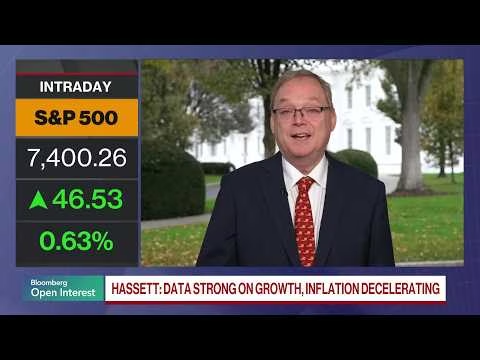
Kevin Hassett’s narrow argument about the October employment report is defensible, but inflation data and subsequent Federal Reserve records leave a December rate increase as the stronger baseline.
Overview
One strong employment report cannot determine monetary policy by itself, so Kevin Hassett is right on the narrow analytical point. But his November 6 argument has been overtaken by broader evidence: October inflation remained firm, Federal Reserve minutes showed near-consensus that additional tightening would probably be appropriate, and markets moved toward expecting a December increase. The jobs report matters chiefly because it suggests the labor market may be able to withstand higher rates—not because payroll growth automatically requires them.
Facts
- The Bureau of Labor Statistics reported on November 6 that nonfarm payroll employment rose by a preliminary 165,000 in October, while unemployment changed little at 4.1%. The payroll gain exceeded the 48,000 monthly average over the preceding 12 months. (bls.gov)
- BLS revised the combined August and September payroll gains upward by 84,000. Average hourly earnings increased 0.4% in October and 3.1% from a year earlier. (bls.gov)
- The number of people working part time for economic reasons rose by 339,000 to 4.8 million, while labor-force participation changed little at 61.9%. (bls.gov)
- The Federal Open Market Committee held its target range at 3.75% to 4% on October 28 by a 10-2 vote. Lisa Cook and Beth Hammack preferred an immediate quarter-point increase. (federalreserve.gov)
- The next FOMC meeting is scheduled for December 8-9. November employment data are scheduled for December 4 and November consumer-price data for December 10, after the decision. (federalreserve.gov)
Hassett’s claim should be understood as a warning against a mechanical policy rule: payrolls rise, therefore rates must rise. The Federal Reserve does not operate that way. It evaluates employment, inflation, wages, demand, productivity, financial conditions and the probable lagged effects of previous decisions. Even a payroll increase substantially above the recent average can coexist with signs of underused labor or slowing demand.
October’s report contains that mixture. The 165,000 payroll increase and upward revisions indicate more momentum than earlier estimates suggested. Yet the unemployment rate was little changed, participation remained subdued and involuntary part-time employment increased. Those details do not negate the headline gain, but they make it insufficient as a stand-alone instruction for policy.
The stronger counterargument is that the Fed does not need the jobs report to prove overheating. It needs to determine whether employment is resilient enough to permit additional action against inflation. On that question, October’s figures strengthened the case for a rate increase. Payroll growth accelerated without a meaningful rise in unemployment, wages increased 0.4% during the month, and the industries adding jobs extended beyond one narrow sector. This suggests—without proving—that another quarter-point increase could be absorbed without immediately destabilizing employment.
Inflation then shifted the balance further. The October consumer-price report showed a 0.4% monthly increase in the headline index, including higher food, shelter and energy prices, while the core index rose 0.3%. (bls.gov) Those readings followed a September meeting cycle in which Fed staff already judged inflation to be elevated. Minutes released November 18 said almost all participants expected further rate increases would probably be appropriate under their baseline outlooks. (federalreserve.gov)
Market evidence reflects that progression rather than the employment report alone. By November 21, futures-derived estimates placed the probability of a quarter-point December increase at about 88%, compared with a 12% probability of no change. That pricing is a market inference, not a Federal Reserve commitment, and it can move before the meeting. (condoredge.com)
Hassett’s position also has an institutional dimension. He is the White House’s National Economic Council director and a member of the committee examining allegations against Governor Lisa Cook. The White House established that inquiry in October; Cook’s lawyers subsequently said she would not participate under the process as presented. (whitehouse.gov) The allegations and Cook’s response do not establish anything about the appropriate interest rate. But combining White House commentary on rates with an inquiry involving a voting Fed governor can sharpen concern about perceived political pressure on monetary policy.
The bounded conclusion is therefore narrower than either side’s rhetoric. The October jobs report did not compel a December increase. It did, however, remove one potential obstacle to tightening by showing continued employment resilience. When combined with firm inflation and the Fed’s own published deliberations, the available evidence as of November 22 favors a hike more strongly than it did when Hassett spoke.
Context / evidence
The Fed entered November balancing a stable labor market against inflation above its 2% objective. Its October minutes estimated September headline personal consumption expenditures inflation at 3.6% and core inflation at 3.1%. (federalreserve.gov) BLS subsequently reported that consumer prices rose 0.4% in October and core prices increased 0.3%. (bls.gov) That sequence matters: Hassett’s Bloomberg remarks were published on November 6, four days before the October inflation release and 12 days before publication of the Fed minutes.
Impact
For households and businesses, the relevant consequence is the path of borrowing costs. A quarter-point increase would directly lift short-term benchmark rates and could keep credit-card, business and some variable-rate borrowing expensive, although longer-term yields also respond to inflation expectations and market conditions. The Fed’s current 3.75%-4% target already influences spending and investment decisions. (federalreserve.gov) For the administration, arguing against a direct jobs-to-rates link is economically reasonable; appearing to prescribe the Fed’s conclusion carries a separate institutional risk, particularly while the Cook inquiry remains unresolved.
Outlook
The December decision will turn on whether officials interpret October’s data as evidence of persistent excess demand or as an unusually strong month within a slower hiring trend. The clearest tests before December 9 are the November 25 PCE release, December 1 job-openings report and December 4 employment report. A material drop in inflation, hiring or financial conditions could revive the case for holding. Continued price pressure with unemployment near 4.1% would reinforce a quarter-point increase. The size and durability of any 2027 tightening cycle remain less certain than the December move itself.