Israel’s opposition won leverage, not power, in bid to unseat Netanyahu
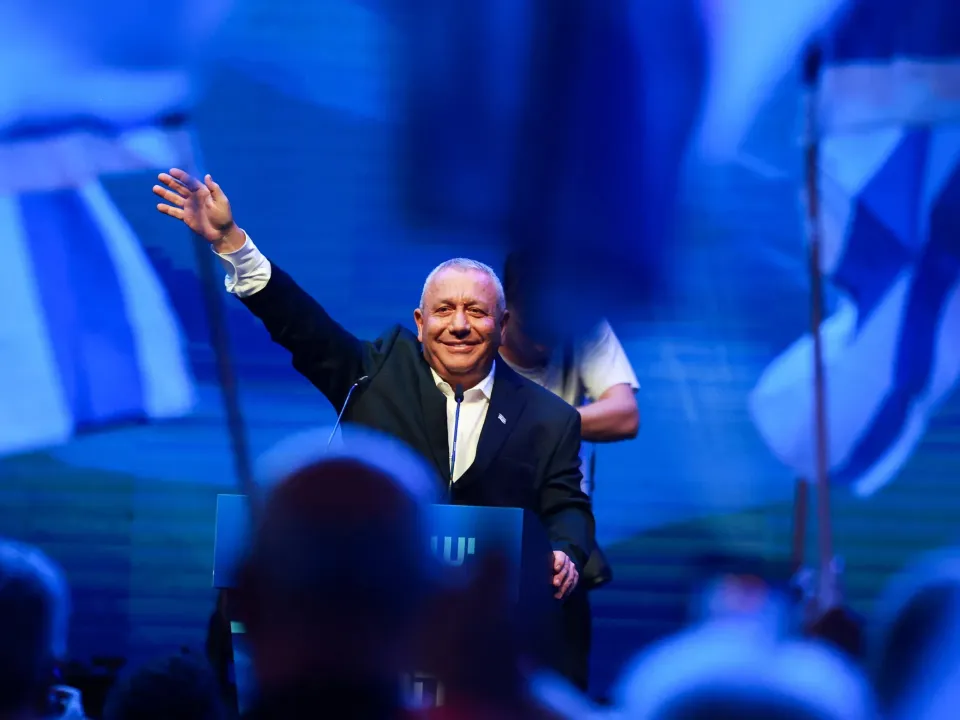
Gadi Eisenkot emerged as Benjamin Netanyahu’s principal challenger, but Israel’s inconclusive election shifted the contest from candidates to coalition arithmetic. Removing Netanyahu now depends on whether opposition leaders can negotiate with Arab-led parties without fracturing their own bloc.
Overview
Israel’s opposition demonstrated that it can deny Benjamin Netanyahu’s existing alliance an outright parliamentary majority, but it did not establish a unified alternative government. The central obstacle is no longer a shortage of prominent challengers: Gadi Eisenkot, Naftali Bennett, Yair Lapid, Yair Golan and Avigdor Liberman collectively command substantial support. It is whether they will accept the parliamentary participation of Arab-led parties, whose projected seats could convert an anti-Netanyahu plurality into a governing majority. That decision will determine whether the election produces political change or another period of caretaker rule.
Facts
- Israel held its election for the 120-seat Knesset on October 27, 2026; a governing coalition requires at least 61 seats. (timesofisrael.com)
- With almost 90% of ballots counted on October 28, Netanyahu’s allied parties were projected to hold 53 seats, Eisenkot’s bloc 48 and the two Arab-led lists 19. The figures remained provisional. (timesofisrael.com)
- Likud was leading the partial count, followed by Eisenkot’s Yashar. Bennett and Lapid’s B’Yachad, Golan’s Democrats and Liberman’s Yisrael Beiteinu formed the other principal components of Eisenkot’s bloc. (timesofisrael.com)
- The separately counted ballots included votes from soldiers, diplomats, prisoners and others unable to vote at their assigned polling stations. (timesofisrael.com)
- President Isaac Herzog said he would consult every parliamentary faction after receiving the official results and urged parties to avoid another election. (apnews.com)
Main narrative
Before the vote, Israel’s anti-Netanyahu camp could be described as a field of candidates. After it, that field has become a hierarchy. Eisenkot, a former military chief leading the centrist Yashar party, is the only challenger positioned to claim the premiership. His allies nevertheless retain enough ideological and parliamentary independence to determine whether his candidacy becomes a viable government.
Eisenkot’s appeal rested partly on offering a security-focused alternative without requiring right-leaning voters to cross into the traditional left. He served as an observer in Netanyahu’s war cabinet after the October 7, 2023, attacks, then left in June 2024 while arguing that political considerations were obstructing Israel’s war objectives. His campaign supported a state inquiry into the October 7 failures, broader military conscription and continued military pressure on Israel’s adversaries. That profile helped him consolidate opposition leadership, but it did not remove the coalition contradictions that repeatedly protected Netanyahu. (apnews.com)
Bennett and Lapid supplied another component through B’Yachad. Bennett can appeal to voters on the right who oppose Netanyahu, while Lapid represents an established centrist and liberal constituency. Golan’s Democrats are more willing to make Jewish-Arab political cooperation explicit. Liberman, by contrast, combines opposition to Netanyahu and ultra-Orthodox draft exemptions with positions that make an agreement with Arab-led parties more difficult. The opposition therefore agrees on replacing Netanyahu more readily than it agrees on who may legitimately provide the votes to do so.
That contradiction is now decisive. The provisional alignment of 48 seats for Eisenkot’s bloc and 19 for the Joint List and Ra’am creates a mathematical route to 61. Yet arithmetic does not create political consent. Eisenkot has left open conditional cooperation with Arab-led parties, while seeking commitments concerning Israel’s Jewish and democratic character, Hamas and national service. Some of his prospective partners entered the election rejecting such cooperation. Arab leaders, meanwhile, are seeking substantive equality and influence rather than serving merely as parliamentary votes against Netanyahu. (apnews.com)
A credible counterargument is that Netanyahu remains better placed because Likud is the largest party, his partners form a more cohesive bloc and his long experience gives him an advantage in coalition bargaining. The partial count supports the first two points: his alliance was ahead of Eisenkot’s bloc, even though it remained eight seats short of a majority. But leading the largest bloc is not equivalent to controlling the Knesset. Netanyahu would still need defections, a unity deal or support from parties his campaign treated as unacceptable. (timesofisrael.com)
The election therefore did not settle which candidate can unseat Netanyahu. It identified Eisenkot as the principal challenger and exposed the institutional choice facing the wider opposition: accept a more inclusive coalition formula, compromise with Netanyahu or risk leaving him in office while the political system moves toward another election.
Context / evidence
The October 26 Al Jazeera report framed the election around the candidates seeking to replace Netanyahu, but the vote two days later clarified the hierarchy among them: Eisenkot became the principal opposition leader, while Bennett, Lapid, Golan and Liberman became essential coalition partners rather than parallel contenders. Partial returns also showed Likud remaining the largest individual party. Because Israelis elect party lists rather than a prime minister directly, neither personal popularity nor first place guarantees office; Herzog can assign government formation to the legislator he judges most capable of assembling a majority. (apnews.com)
Impact
The immediate consequence is institutional uncertainty rather than a transfer of power. Government formation will affect who controls ministries, the legislative agenda and decisions on military conscription, an inquiry into the October 7 attacks and relations between Jewish and Arab citizens. Netanyahu retains caretaker authority unless another government wins parliamentary confidence. The strong showing by Arab-led parties also gives their leaders unusual bargaining leverage, but the returns alone do not establish that they will enter a coalition or support one externally. For Eisenkot, converting that leverage into government requires concessions that could cost him right-wing partners. (apnews.com)
Outlook
The first indicator will be the certified seat distribution, followed by each faction’s recommendation to Herzog. Eisenkot’s prospects would improve if B’Yachad and Yisrael Beiteinu soften their resistance to cooperation with Arab-led parties, whether through coalition membership or external support. Netanyahu’s prospects would improve if he persuades one opposition faction to join him, potentially by offering a unity arrangement or distancing himself from contentious partners. If neither side reaches 61 votes, a minority administration, an unstable unity government or another election becomes possible; Netanyahu would remain caretaker during an unresolved formation process. (apnews.com)