A Netanyahu defeat could curb Israel’s far right without transforming Palestinian policy
Israel’s election may remove Benjamin Netanyahu, but the coalition that replaces him—not the identity of the prime minister alone—will determine whether Palestinians see more than a change in tone.
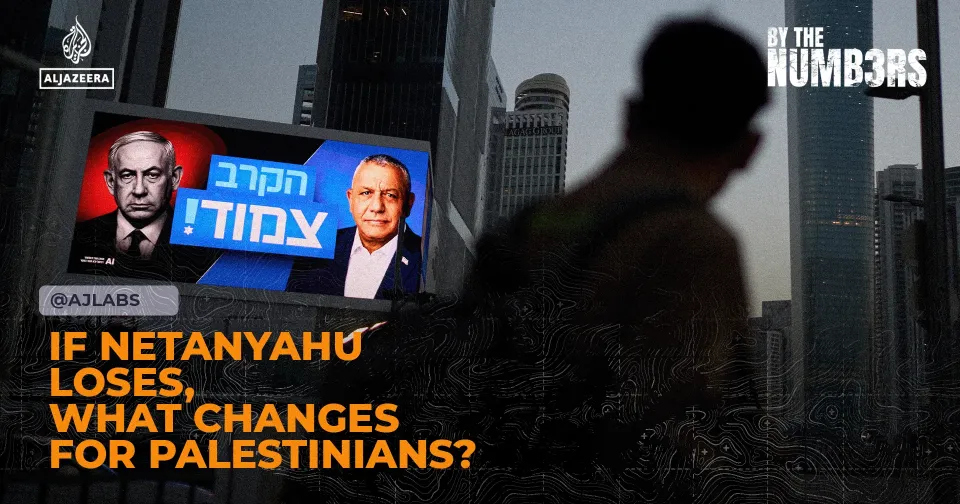
Overview
A Netanyahu defeat could restrain the far-right parties that accelerated settlement expansion and pressed for permanent Israeli control, creating limited openings on humanitarian access, settler violence and regional diplomacy. It would not, on the available evidence, produce a fundamental turn toward Palestinian sovereignty. The leading opposition figures broadly retain Israel’s security objectives in Gaza and reject Palestinian statehood in the near term. With the October 27 election still unresolved, Palestinians may first confront prolonged coalition bargaining rather than an immediate policy change.
Facts
- Israel voted on October 27, 2026. Exit polls available on October 28 did not give either Benjamin Netanyahu’s bloc or Gadi Eisenkot’s opposition a 61-seat Knesset majority. (apnews.com)
- The exit polls placed the two main blocs at roughly 50–52 seats each and projected about 17–18 seats for Arab-led parties; official results were still pending. (apnews.com)
- Israel’s president consults elected parties and assigns government formation to the candidate judged most likely to assemble a majority. The first candidate can receive up to six weeks. (apnews.com)
- Eisenkot has left open conditional cooperation with Arab-led parties, although prospective opposition partners have resisted such an arrangement. (apnews.com)
- Reported opposition positions include opposition to Palestinian statehood in the near term, resistance to the E1 settlement project and promises to act against West Bank settler violence. (lemonde.fr)
Main narrative
The October 27 vote has not yet established that Benjamin Netanyahu is leaving office. Exit polls released after voting closed showed his bloc and the opposition led by former military chief Gadi Eisenkot both short of the 61 seats needed to govern. Arab-led parties emerged with enough projected seats to become pivotal, but the ideological divisions among Netanyahu’s opponents leave no straightforward alternative coalition. (apnews.com)
That uncertainty matters because replacing Netanyahu and replacing his Palestinian policy are separate political tests. Removing him could end the governing leverage enjoyed by far-right leaders whose ministries helped drive settlement policy and pressure for deeper Israeli control of the occupied West Bank. A different cabinet could also change enforcement priorities: how police and the military respond to settler attacks, whether settlement projects advance, how Palestinian Authority finances are handled and how much humanitarian and commercial access Gaza receives.
Those are consequential decisions. They affect Palestinian movement, land, public services and physical security even without a formal peace process. Opposition representatives have reportedly promised stronger action against settler violence, while Eisenkot has opposed the E1 project, which critics say would severely disrupt Palestinian territorial continuity around East Jerusalem. (lemonde.fr) A government less dependent on ultranationalist parties might also be more responsive to pressure from the United States, European governments and Arab states.
But the ceiling on change is visible in the opposition’s stated positions. Eisenkot should not be treated as a peace candidate simply because he opposes Netanyahu. Reporting on the campaign indicates that he rejects Palestinian statehood, supports defeating Hamas and offers no comprehensive plan to end Israeli control over Palestinians. Other potential coalition partners, including figures from Israel’s right, also oppose Palestinian sovereignty or have supported settlements. (lemonde.fr)
The credible counterargument is that limited changes could accumulate into a strategic opening. A government that blocks irreversible settlement measures, disciplines violent settlers, improves Gaza access and permits Arab-backed Palestinian institutions to assume greater responsibilities could preserve options that Netanyahu’s coalition has narrowed. Opposition contacts cited by The Atlantic described possible phased governance changes in Gaza rather than requiring every security objective to be completed before a political transition begins. (theatlantic.com)
Yet that remains a possibility, not an adopted programme. Coalition arithmetic may further dilute it. Eisenkot’s easiest numerical path may require support from Arab-led parties, but accepting that support could cost him right-wing partners. Refusing it could leave Netanyahu in office, produce a broad unity arrangement with little appetite for Palestinian concessions, or trigger another election. The immediate Palestinian stake is therefore institutional: whether the result changes who controls ministries and parliamentary votes, and whether those officials alter specific policies—not whether Netanyahu’s departure alone resolves the conflict.
Context / evidence
The strongest evidence for limited change lies in the opposition’s own distinctions. Its figures have criticised Netanyahu’s diplomatic isolation, far-right partners and failure to connect military operations to an achievable political outcome. Yet reported platforms retain forceful security policies, oppose near-term Palestinian statehood and contain no firm commitment to reverse settlement expansion. (lemonde.fr) The relevant comparison is therefore not peace versus conflict, but different ways of administering an unresolved conflict.
Impact
No post-election Palestinian policy effect is yet established because final results and a governing coalition remain outstanding. If the far-right parties lose executive authority, the most immediate implications would concern settlement approvals, policing in the West Bank, transfers to the Palestinian Authority and Gaza access. Arab-led parties could also gain unusual bargaining power if their votes are required to seat a government. Conversely, excluding them may preserve the political veto against Palestinian-centred concessions even under a new prime minister. (apnews.com)
Outlook
The first indicator will be whether final results give Eisenkot a viable route to government with Arab-party support. The next will be the coalition agreement: control of the defence, finance, foreign affairs and national security portfolios will matter more than campaign language. Decisions on E1, settlement authorisations, settler policing, Palestinian Authority revenues and Gaza access would reveal whether personnel change is producing administrative change. If coalition negotiations fail, Netanyahu could remain caretaker prime minister while Israel moves toward another election, postponing even limited policy departures. (apnews.com)