Trump’s Netanyahu Endorsement Raises Iran War Risk but Is Not an Attack Order
Trump’s endorsement strengthens Netanyahu politically and reinforces pressure on Tehran, but it does not establish that Washington has authorized another attack.
Overview
The clearest judgment as of October 23 is that Donald Trump’s endorsement of Benjamin Netanyahu is part of a broader coercive strategy toward Iran, not evidence by itself of a final attack order. Subsequent reporting indicates that US officials are considering renewed strikes after the November 3 midterm elections, while Trump has so far withheld authorization for a pre-election operation. The danger lies in how political commitments, military preparations and confrontation around the Strait of Hormuz can narrow the space for either government to step back.
Facts
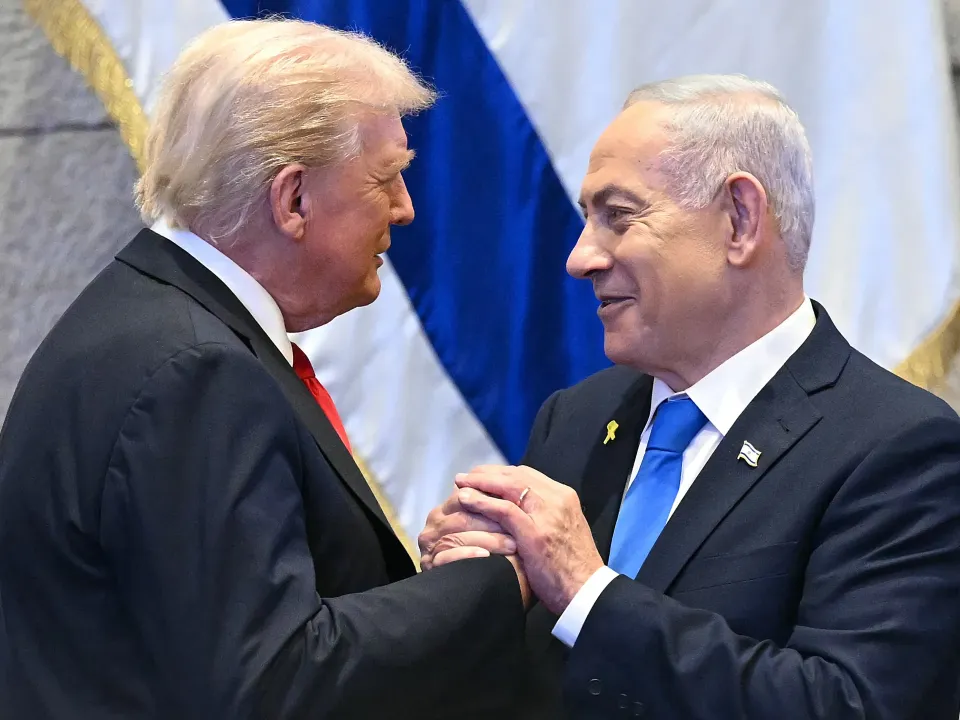
- Trump endorsed Netanyahu on October 18, nine days before Israel’s scheduled October 27 election. (apnews.com)
- Trump’s endorsement threatened that the US and Israel would “soon finish the job” against Iran unless Tehran changed course. (apnews.com)
- Axios reported on October 13 that the leaders had discussed a possible operation, but the White House denied that they discussed resuming the war and said Trump would not attack before the US midterms. (axios.com)
- On October 20, Netanyahu publicly said he had discussed Iran with Trump and presented regime change as an Israeli objective. (gov.il)
- The Atlantic reported on October 22 that US officials were considering several days of strikes after the November 3 elections, while stressing that no decision had been made. (theatlantic.com)
Main narrative
Trump’s endorsement matters because it binds two previously separable questions: who should govern Israel and how the United States should handle Iran. By portraying Netanyahu as Washington’s required partner and linking his reelection to completing the campaign against Tehran, Trump converted a foreign-election intervention into a strategic signal. The message gives Netanyahu material for his argument that his personal relationship with the US president is an Israeli security asset. It also makes any later American attempt to distance itself from Netanyahu’s war policy politically harder.
That signal, however, should not be confused with an operational decision. Before the endorsement, Axios reported that the leaders had discussed the possibility of another major campaign against Iranian military and nuclear targets. Its account also recorded a categorical White House denial and described Trump as unwilling to strike before the US midterms. (axios.com) The conflicting accounts establish deliberation and uncertainty, not authorization.
Developments after the October 19 Al Jazeera report strengthen the case that military options remain active. Netanyahu said on October 20 that he and Trump had discussed Iran while presenting the elimination of the Iranian government as an objective. (gov.il) On October 22, The Atlantic reported that the administration was considering a short post-midterm campaign against Iranian energy infrastructure, nuclear facilities and missile and drone capabilities. The same report said officials continued to emphasize that no decision had been reached. (theatlantic.com)
The likely mechanism is pressure rather than a settled timetable. Trump can use visible preparations and his renewed alignment with Netanyahu to persuade Tehran that continued resistance risks another attack. Netanyahu, meanwhile, gains both electoral endorsement and greater credibility for his threat that Israel retains American backing. Each leader therefore has an incentive to preserve uncertainty. The problem is that coercive ambiguity works only if the opponent believes the threat, and that credibility can eventually create pressure to act.
There are credible restraints. A new offensive could provoke Iranian retaliation, disrupt Israel’s election and worsen energy costs before US voting. Axios reported that Israeli military leaders had considered the possibility that renewed fighting could force the Israeli election to be postponed. (axios.com) Trump also faces an unresolved choice between advisers favoring military escalation and those arguing that sanctions and blockade pressure should continue.
The immediate escalation risk may consequently come less from a preplanned joint attack than from an incident that changes the political calculation. Iran reported seven tankers damaged or burning overnight in the Strait of Hormuz, although the Associated Press could not independently confirm Tehran’s account. The US has also been adding military assets to the region. (apnews.com) In that environment, a maritime attack, casualties or a perceived move in Iran’s nuclear program could supply the justification for action that political rhetoric and military preparations have already made easier to execute.
Context / evidence
The leaders’ alignment is neither new nor complete. The US and Israel began the current war with attacks on Iran on February 28, but Trump and Netanyahu subsequently differed over Israeli operations, diplomacy and how far the conflict should expand. (apnews.com) Earlier in October, officials cited by Axios described disagreement inside the administration: some supported renewed strikes, while others favored allowing sanctions and the naval blockade more time. The White House’s denial of an agreed operation remains a material counterweight to reports of planning. (axios.com)
Impact
For Israel’s institutions, Trump’s intervention strengthens Netanyahu’s campaign claim that leadership choice affects access to Washington, but it cannot itself provide the parliamentary majority required to govern. Analysts interviewed by Al Jazeera cautioned that fragmented parties and dissatisfaction with Netanyahu remain decisive electoral constraints. (aljazeera.com) For US institutions, the central issue is presidential authorization: planning and deployments can increase readiness without proving that an operation has been approved. Diplomatically, the public alignment reduces Tehran’s incentive to distinguish between US and Israeli objectives, potentially making compromise more politically difficult for all three governments. (aljazeera.com)
Outlook
The first decision point is Israel’s October 27 election; the second is the US midterm vote on November 3. A pre-midterm operation appears less likely unless an Iranian action produces a US or Israeli decision to retaliate. After November 3, indicators of a shift would include an explicit White House authorization, additional force deployments tied to offensive operations, failed diplomatic contacts or formally expanded war aims. Continued indirect talks, restraint in Hormuz or renewed ceasefire terms would support the alternative scenario: military preparations remain coercive leverage rather than the prelude to an approved campaign.