Gaza’s fragile food gains face reversal as WFP cuts collide with access and winter risks
Funding cuts are removing food support just as restricted supply routes, damaged services and winter exposure leave Gaza’s recent nutritional gains vulnerable to reversal.
Overview
Gaza’s humanitarian crisis has not been averted; the narrower question is whether renewed deterioration can still be prevented. The evidence indicates that it can, because expanded assistance previously reduced the severity of hunger. But food aid alone cannot secure those gains. WFP’s funding-driven cuts are colliding with restricted cargo capacity, weak commercial markets, damaged water and health systems, continuing violence and inadequate winter shelter. Unless funding and physical access improve together, agencies will increasingly ration support among households whose ability to cope is already severely depleted.
Facts
- WFP reduced its Gaza caseload from 1.6 million people in September to 1.1 million in October because of insufficient funding. (friends.wfp.org)
- WFP halved family food rations, cut its daily hot meals from 250,000 to 150,000 and reduced cash support for 75,000 families. (friends.wfp.org)
- An estimated 1.4 million people, or 67 percent of Gaza’s population, faced Crisis-level or worse acute food insecurity; about 200,000 were in Emergency conditions. (friends.wfp.org)
- OCHA reported that daily cooked-meal production across humanitarian partners fell from 695,000 in late September to about 614,000 in early October. (ochaopt.org)
- WFP said it required $450 million to sustain critical operations in Gaza and the West Bank from October 2026 through March 2027. (friends.wfp.org)
Main narrative
The most important evidence in Gaza is not only the scale of present need, but the mechanism behind the limited improvement recorded since the October 2025 ceasefire. Food insecurity eased when aid and commercial supplies increased. That establishes that deterioration is not inevitable. It also shows why withdrawing support before households, markets and public services recover is particularly dangerous.
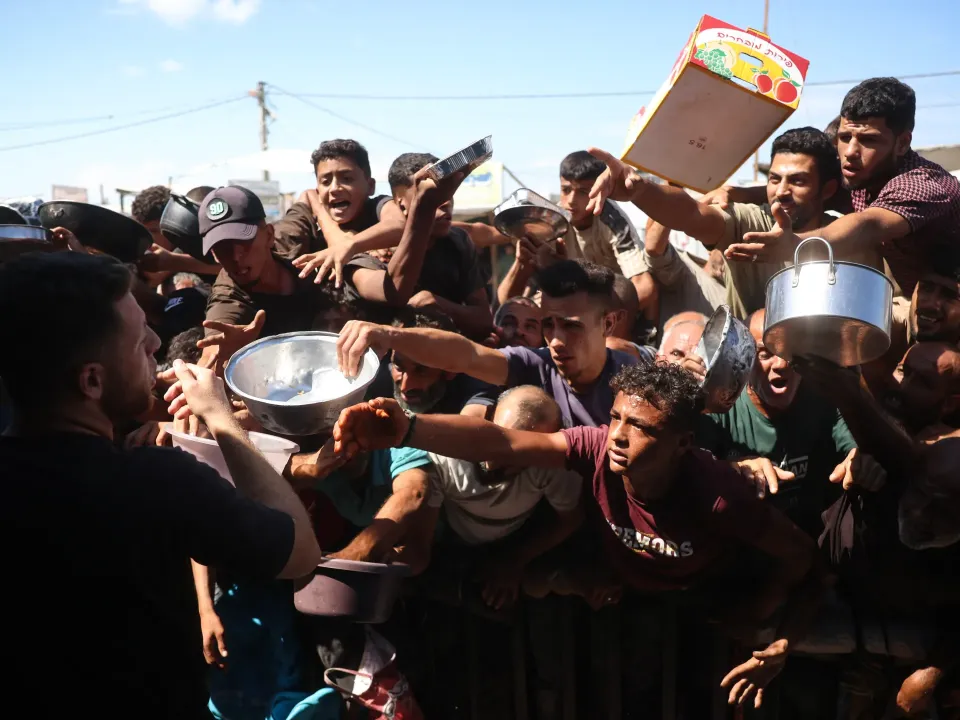
WFP’s October reductions remove part of the intervention credited with protecting those gains. The agency is now supporting 1.1 million people, down from 1.6 million the previous month. Remaining recipients face smaller rations, fewer hot meals and reduced cash assistance. WFP says the reductions reflect funding scarcity rather than falling need or an inability to bring its available food into Gaza. (friends.wfp.org)
That distinction matters. It identifies donor funding as the immediate cause of WFP’s retrenchment and prevents access restrictions from becoming an all-purpose explanation. Yet it does not make access secondary to the wider humanitarian trajectory. OCHA reported that Kerem Shalom remained the sole operational cargo crossing, while inspection, customs and handling delays constrained the regularity of supplies. Between September 29 and October 12, 807 of 937 manifested humanitarian trucks were offloaded through several supply corridors feeding that crossing system. (ochaopt.org) A temporary halt to commercial shipments added another vulnerability; Israeli authorities said on October 19 that coordination would resume, but the reviewed reporting does not establish how much traffic subsequently entered. (apnews.com)
Commercial supply is not interchangeable with humanitarian aid. Agencies generally provide staples, while markets can supply fresh food and other goods, diversify diets and reduce the cost of cash-based assistance. If markets contract, aid agencies must stretch fixed budgets across more needs. If cash assistance is reduced while prices remain high, households lose purchasing power even when goods are physically present.
The food cuts also interact with failures outside the food system. OCHA recorded drinking-water production during October 6–12 at 66 percent of its mid-September weekly level. Fuel, spare-parts and medicine shortages threatened dialysis, cancer care and other essential services. (ochaopt.org) These conditions can undermine nutrition because unsafe water and disease reduce the body’s ability to benefit from limited food, especially among children.
Winter adds a separate exposure pathway. About 950,000 displaced people were assessed as living at sites with medium-to-high flood risk, including more than 400,000 at high risk. Available supplies could partially assist only 18 percent of the families identified as needing winter shelter support. (ochaopt.org) Rain, flooding and damaged shelter could therefore increase illness, displacement and household spending precisely as food assistance contracts.
A credible counterpoint is that famine conditions were pushed back and some indicators improved, demonstrating that humanitarian operations retain substantial capacity. That is true, but it supports rather than weakens the central judgment: the improvement followed a scale-up and remains dependent on it. Gaza can avoid another sharp decline only if funding restores basic coverage while access, markets and essential services become sufficiently reliable to reduce long-term dependence on emergency distributions.
Context / evidence
The strongest evidence that further decline is preventable is Gaza’s earlier improvement. A joint UN assessment attributed reduced food insecurity and malnutrition primarily to expanded humanitarian assistance and commercial supplies rather than restored local production. (wfp.org) The latest OCHA report covers September 29 through October 12, while WFP announced its reductions on October 19; neither record measures the cuts’ subsequent nutritional effects. Al Jazeera’s October 20 programme framed the resulting policy debate but did not provide a later outcome assessment. (aljazeera.com)
Impact
The immediate observed effect is thinner assistance: fewer recipients, half-sized ration provision, 100,000 fewer WFP hot meals each day and lower cash support. (friends.wfp.org) WFP intends to prioritize people facing the highest risks and rotate some assistance rather than necessarily cut every affected household off permanently. (transcripts.un.org) For families without stable income, the plausible consequences are fewer meals, less dietary diversity and harder choices among food, water, medicine and shelter. Those outcomes have not yet been quantified for the October cuts, but existing monitoring found that 44 percent of surveyed households had gone to bed hungry during the preceding month. (ochaopt.org)
Outlook
The first decision point is whether donors close enough of WFP’s stated $450 million requirement to restore monthly coverage, full rations and daily meals. The second is whether Israeli authorities permit predictable humanitarian and commercial cargo movements, including equipment and materials needed for water, health and shelter services. Observable indicators include WFP’s caseload and meal output, truck offloading volumes, the number of operational cargo crossings, market prices, drinking-water production, malnutrition admissions and entry of winter shelter kits. Improvement across only one measure would offer relief, but not durable stabilization; deterioration across several would signal that earlier food-security gains are being reversed.