CoreWeave’s Debt Scare Tests the Financing Model Behind the AI Boom
CoreWeave’s bond sell-off exposes the central financing risk in the AI infrastructure boom: demand can be strong while the capital required to serve it becomes too expensive.
Overview
CoreWeave’s market turmoil is not evidence of an imminent default, but it is a meaningful test of whether debt-intensive AI infrastructure can generate returns above its rising cost of capital. The company retains several financing routes and substantial contracted demand. The analytical risk is that more expensive funding narrows the margin between the revenue produced by new computing capacity and the cost of building it, forcing slower expansion or greater shareholder dilution.
Facts
- Bloomberg reported that CoreWeave shares fell more than 3% in premarket trading on Tuesday, October 20, 2026. They subsequently closed at $62.13, up about 1.6% for the session, illustrating the volatility surrounding the credit debate rather than a one-directional market judgment. (finance.yahoo.com)
- CoreWeave reported $2.575 billion of second-quarter revenue, a $626 million net loss and $640 million of net interest expense for the three months ended June 30, 2026. Its stated revenue backlog was approximately $104 billion at quarter-end. (investors.coreweave.com)
- The company’s June quarterly filing listed $35.551 billion of future principal payments, including $4.413 billion during the remainder of 2026 and $6.184 billion in 2027. (sec.gov)
- CoreWeave issued convertible notes in September that produced $4.137 billion of net proceeds before offering expenses. The notes carry a 2.875% annual coupon and mature in 2033. (investors.coreweave.com)
Main narrative
CoreWeave has become a particularly visible measure of AI financing risk because its growth model compresses two very different timelines. Computing capacity requires large expenditures on GPUs, networking equipment, power and leased facilities before customers generate the corresponding revenue. Contracts may extend for years, but hardware and construction bills arrive much earlier. Debt bridges that timing gap.
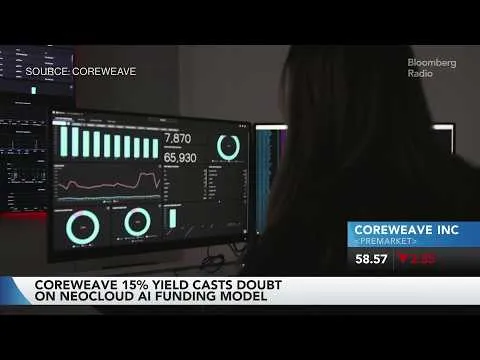
The model works when contracted revenue is dependable and the return from each deployment comfortably exceeds financing, operating and depreciation costs. It becomes fragile when the cost of raising the next dollar increases. CoreWeave’s unsecured bonds traded at yields around 15% during the October sell-off, while some debt prices fell to levels commonly associated with distressed credit. (bloomberg.com) Those secondary-market yields do not automatically reprice every existing obligation, but they communicate what investors currently demand for taking unsecured CoreWeave risk.
The financial statements explain the sensitivity. CoreWeave’s second-quarter revenue more than doubled from a year earlier, yet net interest expense reached $640 million and the company remained loss-making. For the first half, debt-service cash requirements totaled approximately $6.2 billion, including principal and interest payments. (sec.gov) Rapid revenue growth therefore does not settle the financing question: expansion itself creates the need for additional capital.
The transmission mechanism runs from credit markets to deployment economics. If new borrowing becomes more expensive, CoreWeave can accept lower returns, charge customers more, contribute additional equity or slow construction. Higher customer prices could weaken demand or encourage large AI developers to use competing clouds and internal infrastructure. Additional equity can preserve liquidity but dilute existing shareholders. Slower building would conserve cash but could limit CoreWeave’s ability to satisfy contracted commitments and capture demand.
There are important offsets. CoreWeave reported approximately $104 billion of revenue backlog at June 30 and said in September that it had added more than $25 billion of net new customer commitments early in the third quarter. It also reported contracting some short-duration capacity at higher prices. These are company disclosures, not guarantees that all projected revenue will arrive with the expected timing or margin, but they indicate that the credit sell-off did not originate from a documented collapse in customer orders. (investors.coreweave.com)
Nor is unsecured debt CoreWeave’s only option. Its September convertible issue carried a 2.875% coupon, although conversion features can transfer value to investors and potentially dilute shareholders. The company has also created an at-the-market program covering up to 35 million shares and has used facilities secured by assets or contractual cash flows. (investors.coreweave.com)
The bounded judgment is therefore narrower than a claim that the AI boom is breaking. CoreWeave has demand and continuing access to capital, but the market is challenging whether future capacity can be financed on terms that leave sufficient value for equity holders. The decisive variable is not the size of the backlog by itself. It is the spread between cash returns from that backlog and the all-in cost of the infrastructure needed to deliver it.
Context / evidence
CoreWeave’s filings show why the market is focusing on financing rather than demand alone. During the first half of 2026, the company generated $3.663 billion of operating cash but spent $14.117 billion on property and equipment. It financed the resulting gap partly through $16.747 billion of net debt issuance and almost $3 billion of private-placement equity proceeds. (sec.gov) The company itself warns that insufficient financing could restrict the capital expenditure needed to satisfy customer contracts. (sec.gov) Those disclosures support the causal link between capital-market access and the company’s ability to turn contracted demand into operating capacity.
Counterpoint / knowledge gaps
The strongest alternative is that distressed unsecured-bond yields exaggerate CoreWeave’s actual funding cost. Goldman Sachs argued that this market was already effectively closed to new CoreWeave issuance and that contract-backed project finance is more relevant to future borrowing. The September convertible sale also demonstrated access to lower-coupon capital. (axios.com) The unresolved questions are CoreWeave’s current blended marginal funding cost, the returns expected from each financed deployment and how much backlog will convert into cash on schedule. Financing secured at moderate spreads, improving free cash flow and falling leverage would weaken the stress thesis. Costly secured borrowing, equity issuance at depressed prices, project delays or reduced capital spending would strengthen it.
Impact
The demonstrated effect so far is financial-market volatility, not a reported interruption to CoreWeave’s services or construction program. If elevated funding costs persist, however, management and lenders may apply stricter return thresholds to new deployments. That could affect equipment purchases, data-center development and the pace at which customers receive new AI capacity. For investors, alternative financing can shift rather than eliminate risk: secured debt gives lenders stronger claims, while convertible or common-equity issuance can dilute existing holdings. For the wider sector, CoreWeave’s transactions may influence how lenders price other capital-intensive AI-cloud projects, though one borrower cannot establish an industry-wide outcome.
Outlook
The next phase will be determined less by daily bond quotations than by executed financing and cash conversion. A favorable scenario would combine contract-backed funding at materially lower rates than unsecured bond yields, timely capacity deployment and operating cash growth that reduces dependence on repeated capital raises. A constrained scenario would feature higher secured-financing spreads, increased reliance on equity or convertibles, or slower construction. CoreWeave’s next financial filing should clarify debt growth and cash use after June, while subsequent transactions will show whether lenders treat the October sell-off as temporary market dislocation or a lasting repricing of AI infrastructure risk.