Klopp’s FIFA attack becomes an electoral signal as Diallo challenges Infantino
The Germany coach’s attack on Gianni Infantino does not determine FIFA’s election, but its timing gives institutional opposition a powerful public argument as Philippe Diallo enters the race.
Overview
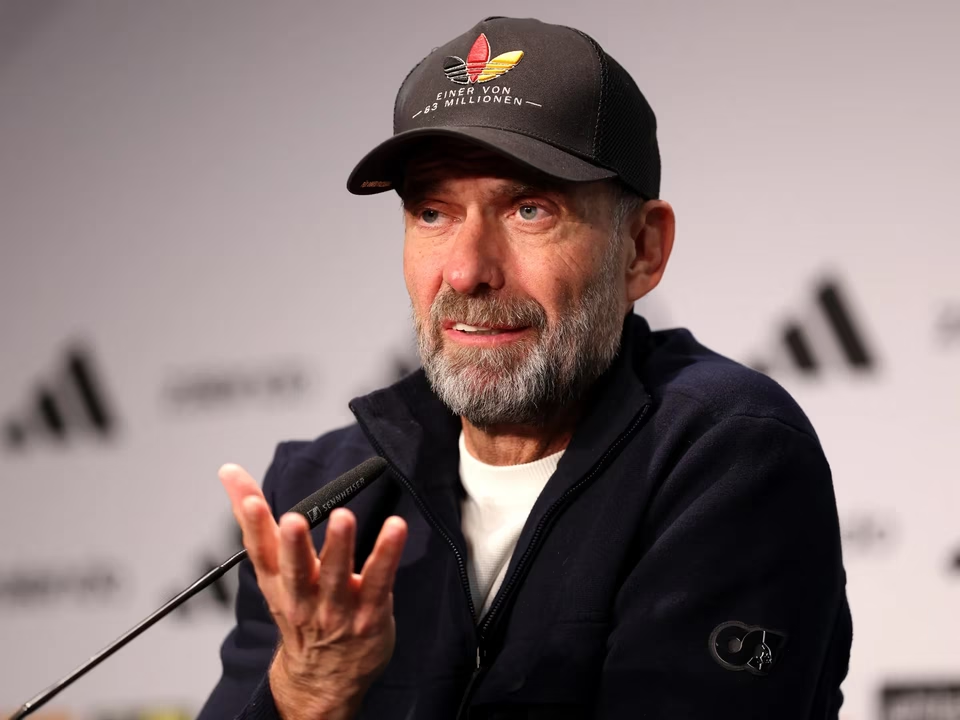
Jürgen Klopp’s comparison of Gianni Infantino with Sepp Blatter is best understood as an electoral signal rather than evidence about FIFA’s performance by itself. The Germany coach cannot deliver votes in the March 2027 presidential election, and the reporting does not establish that his intervention changed any association’s position. It matters because Klopp publicly converted complicated disputes about authority, transparency and commercial strategy into a direct leadership question just as European officials secured a candidate against Infantino.
Facts
- Klopp made the remarks in Berlin on November 15, 2026, before Germany’s Nations League match against the Netherlands. He said a change at FIFA would make sense and argued that the organisation had become worse since Blatter’s presidency. (aljazeera.com)
- The German Football Association identifies Klopp as Germany’s men’s national-team coach. (dfb.de)
- Infantino was first elected FIFA president on February 26, 2016, and was re-elected in 2019 and 2023. (inside.fifa.com)
- Infantino announced at the FIFA Congress on May 1, 2026, that he would seek re-election in 2027. (legal.fifa.com)
- UEFA officials backed French Football Federation president Philippe Diallo on November 16. The FFF executive committee ratified his candidacy on November 17, according to the Associated Press. (uefa.com)
- The election is scheduled for March 18, 2027. The nomination period was due to expire at 23:00 GMT on November 18, meaning the final candidate field was not yet settled during the editorial date. (apnews.com)
Klopp’s intervention matters because of the gap between FIFA’s formal electoral system and the way legitimacy is built around it. FIFA presidents are elected by member associations, not coaches, players or supporters. Klopp therefore has no direct electoral bloc to transfer to a challenger. His influence is reputational: he can make it easier for officials already questioning Infantino to portray a leadership challenge as a football issue rather than an internal struggle among administrators.
The timing sharpened that function. Klopp spoke on November 15, saying he believed broad agreement had emerged that change would be sensible and that the next president should care about football rather than financial interests. (aljazeera.com) One day later, European associations represented on UEFA’s executive committee and the FIFA Council unanimously supported Diallo, who accepted their invitation to stand. (uefa.com) The FFF then approved Diallo’s candidacy on November 17. (apnews.com)
The chronology does not establish that Klopp prompted Diallo’s decision. UEFA had already developed governance proposals and publicly called for new FIFA leadership in October. Klopp’s role was instead to amplify a case that institutions had struggled to communicate beyond specialist governance debates. Comparing Infantino with Blatter compresses concerns about decision-making, commercial policy and presidential power into an easily understood verdict: the post-2015 reform era has not restored sufficient confidence.
That framing also carries a risk. Blatter left the presidency during a corruption crisis and remains banned from football by FIFA’s ethics system. Klopp’s comparison is a political judgment, not proof that Infantino committed equivalent wrongdoing. Al Jazeera’s report recorded the criticism alongside disputes over Infantino’s decisions and proposals, but it did not provide a comprehensive performance comparison between the two presidencies. (aljazeera.com) Treating the remark as a factual ranking would therefore go beyond the evidence.
The strongest alternative interpretation is that Klopp’s comments are prominent but electorally marginal. Infantino told FIFA’s 211 associations in May that he would seek another term, while FIFA’s account of his presidency emphasizes financial growth, development spending and expanded participation. (legal.fifa.com) The Associated Press reported that FIFA said Infantino had received about 200 letters of support after the 2026 World Cup. Those letters are not necessarily binding votes, but they illustrate the scale of the coalition a challenger may need to disrupt. (apnews.com)
Diallo’s candidacy nevertheless changes the practical meaning of Klopp’s statement. Criticism now has a potential electoral destination. The causal pathway is limited but identifiable: a respected football figure normalises dissent; a recognised administrator offers an alternative; and associations then decide whether reputational concern outweighs institutional ties, development relationships and confidence in the incumbent’s record. Only the last stage determines the election, and public evidence has not yet shown it occurring.
Context / evidence
European opposition predates Klopp’s comments. Proposals endorsed by UEFA’s national associations on October 8 called for clearer separation between FIFA’s president, council and administration; stronger independent oversight; and a defined process requiring consultation before major decisions. UEFA also said institutional reform would be insufficient without new leadership. (uefa.com) FIFA presents Infantino’s record differently, crediting his presidency with expanded competitions, increased development investment, transfer reforms and the introduction of video review in FIFA tournaments. (inside.fifa.com) These competing accounts establish a substantive governance contest, not an agreed assessment that Klopp’s criticism is correct.
Impact
The observed consequence is a contested debate over FIFA’s leadership rather than proof of an electoral realignment. Diallo can use criticism from figures such as Klopp to argue that dissatisfaction extends beyond UEFA executives, while Infantino can point to FIFA’s development programmes and previous association support. For national associations, the choice may now require a public defence of either continuity or change. For coaches, players and supporters, the candidacy creates a formal channel through which governance complaints can be tested, although they do not themselves hold presidential votes. No documented evidence yet links Klopp’s remarks to a changed endorsement or voting commitment from any association president or executive committee member, so their measurable impact remains open. (apnews.com)
Outlook
The first test is procedural: FIFA’s confirmed candidate list after the November 18 deadline will establish who can actually contest the presidency. The next is geographic. Diallo will need visible support outside Europe, while Infantino must demonstrate that earlier endorsements remain firm once associations face a competitive ballot. Campaign platforms should show whether the contest concerns personality alone or enforceable rules on executive authority, consultation, commercial projects and development funding. Until associations declare positions—or vote in Rabat on March 18, 2027—Klopp’s intervention should be treated as evidence of widening public dissent, not evidence that control of FIFA has shifted.