Gaza’s ‘pink blooms’ campaign turns breast-cancer awareness into an appeal for access
A Gaza breast-cancer campaign turns a global awareness ritual into practical solidarity, while exposing how little awareness can achieve without reliable diagnosis and treatment.
Overview
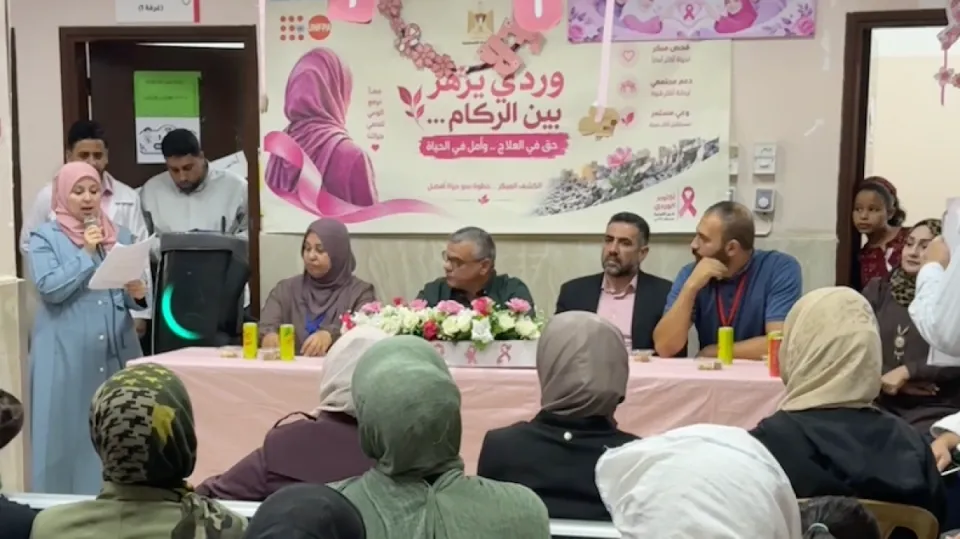
The “pink blooms from among the rubble” campaign shows how a familiar global symbol can be adapted into an act of local care. Health workers are using Pink October to teach breast self-examination, screen women and provide psychological support. The bounded judgment is that this cultural work has practical value, but its medical promise is constrained: identifying a warning sign matters only if patients can subsequently obtain imaging, pathology, surgery, medicines or treatment outside Gaza. The campaign therefore functions simultaneously as health education, solidarity and evidence of a broken care pathway.
Facts
- Al Jazeera reported on October 23, 2026, that Gaza health workers were running a campaign called “pink blooms from among the rubble” to educate and support women with breast cancer. (aljazeera.com)
- At Hekr al-Jameh Health Centre in Deir el-Balah, the campaign teaches breast self-examination and offers psychological support. Its supervisor said between 700 and 800 women had been screened, with seven or eight referred for further assessment. (aljazeera.com)
- Hiba Musbah, 36, told Al Jazeera that treatment shortages delayed her chemotherapy and that she was awaiting travel for specialized care. She had completed seven chemotherapy rounds when the report was published on October 22. (aljazeera.com)
- PCHR reported that Gaza had no radiotherapy services and cited Ministry of Health figures showing depletion of 47 percent of essential medicines, 59 percent of medical consumables and 87 percent of laboratory supplies as of May 7, 2026. (pchrgaza.org)
Main narrative
Pink October normally relies on a recognizable cultural language: pink ribbons, public testimony and reminders to seek screening. In Gaza, “pink blooms from among the rubble” retains that vocabulary but changes its meaning. The imagery is not simply optimistic branding. It places women’s health within a landscape where survival, displacement and family responsibilities compete for attention, and where health workers must persuade women that examining their own bodies remains urgent.
That translation from global symbol to local practice is the campaign’s strongest contribution. At Hekr al-Jameh Health Centre, awareness is attached to specific actions: teaching self-examination, screening women, referring suspicious cases and offering psychological support. (aljazeera.com) The campaign creates permission to discuss a disease that may otherwise be postponed amid immediate emergencies. It also makes cancer patients visible as people with continuing lives and responsibilities rather than as an anonymous category within wartime health statistics.
The causal limit is equally important. Awareness can prompt a woman to notice a change and approach a clinic. It cannot by itself produce a functioning mammography machine, laboratory reagents, pathology analysis, chemotherapy, radiotherapy or permission to travel. Each missing stage increases the chance that the chain between detection and treatment will break. PCHR’s reporting describes shortages across imaging, laboratory testing, medicines and specialist services, while WHO’s public-health assessment says Gaza’s specialized cancer hospital became non-operational in November 2023 and was later destroyed. (pchrgaza.org)
Musbah’s experience gives that mechanism a human scale. According to Al Jazeera, nearby military activity delayed her surgery, unavailable medicines delayed chemotherapy, and the absence of an affordable public CT scan left uncertainty about the progression of her illness. (aljazeera.com) Her case does not establish that every patient follows the same course. It does show how separate obstacles can accumulate: displacement delays presentation, damaged services delay intervention, shortages interrupt treatment and restricted movement blocks access to care elsewhere.
The campaign should therefore not be dismissed as merely symbolic. Symbols can organize attention, sustain community ties and help women articulate needs that might otherwise remain private. But neither should participation or referral numbers be mistaken for successful cancer care. The reported seven or eight referrals establish that the campaign identified women requiring further assessment; they do not establish diagnoses, treatment or outcomes. The campaign’s deeper cultural message is consequently double-edged: self-care is presented as strength, while the conditions needed to act on that self-care remain uncertain.
Context / evidence
WHO’s 2026 campaign says awareness must lead through a complete pathway: timely diagnosis, treatment and supportive care. Its Global Breast Cancer Initiative targets diagnosis within 60 days of presentation and complete recommended treatment for 80 percent of diagnosed patients. (who.int) Gaza’s precise mammography capacity remains unclear. PCHR reported in September that five of 14 prewar machines were operating, while Amos Trust described Al Ahli Hospital as the only hospital with a working mammogram in its programme account. The difference may reflect timing, geography or definitions, but the public records do not reconcile it. (pchrgaza.org)
Impact
The observed effect is increased contact between health workers and women: hundreds were screened or reached during the reported campaign, and a small group was referred for further assessment. (aljazeera.com) The plausible wider benefit is stronger health literacy and social support, especially where displacement has disrupted older outreach networks. Yet referrals can also bring anxiety when confirmatory tests or treatment are delayed. For institutions, the campaign generates actionable demand: clinics and aid organizations can see where information succeeds but diagnostic capacity, medicines and evacuation routes fail to complete the pathway. It does not establish improved survival.
Outlook
The campaign’s value will be tested after October. Indicators include how many referred women receive diagnostic imaging and biopsies, the time between a suspicious finding and confirmed diagnosis, continuity of chemotherapy supplies, access to surgery, and approvals for treatment unavailable inside Gaza. More education sessions would demonstrate reach, not completion of care. If diagnostic and treatment access expands, the campaign’s community networks could become part of a durable early-detection system. If access remains restricted, Pink October will continue to identify needs that local health workers have limited means to meet.