France’s school protests expose a crisis of political representation
The October 17 mobilisation fused demands over schools, public services and living costs. Its political force now depends on whether institutions can separate those grievances from the violence that followed.
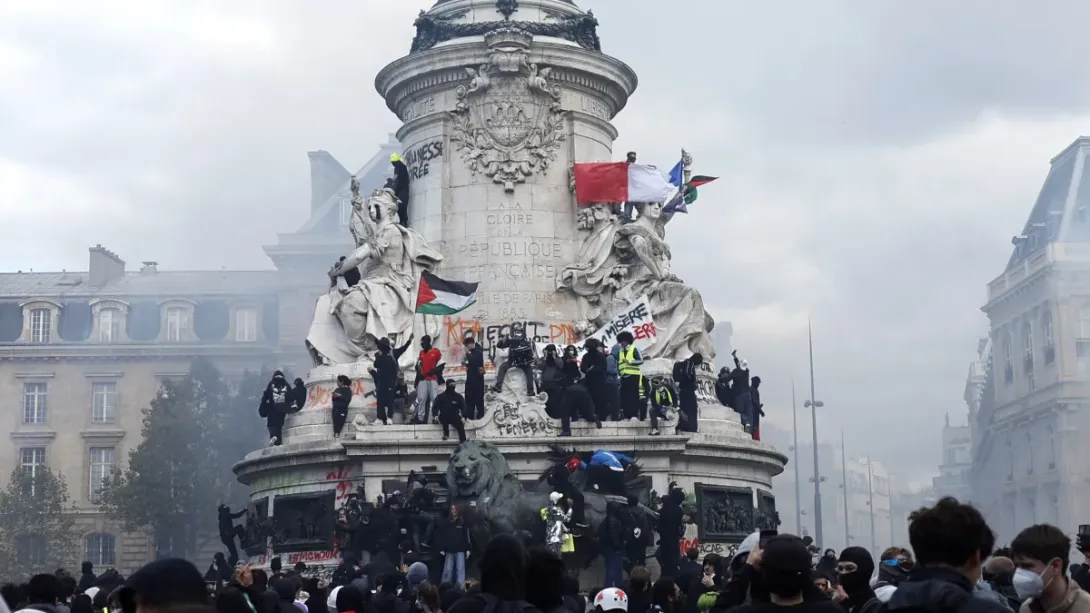
Overview
France’s school protests have become a wider political crisis because they have connected specific failures in education with dissatisfaction over purchasing power, public services and political representation. The bounded analytical judgment is that the October 17 mobilisation exposed an institutional problem rather than proving a revolutionary or electoral realignment: a fragmented Parliament and an unpopular outgoing presidency have limited the government’s capacity to offer a settlement that protesters regard as credible. Violence has simultaneously allowed the executive to shift attention towards public order, risking a cycle in which security decisions displace negotiations over the original grievances.
Facts
- France’s Interior Ministry estimated that about 550,000 people demonstrated nationwide on October 17, according to Al Jazeera and Associated Press reporting.
- The mobilisation brought together high-school and university students, trade unions, public-sector workers and Yellow Vest supporters around education, living-cost and public-service demands.
- Prime Minister Sébastien Lecornu initially reported 1,200 arrests and 150 injured police officers and gendarmes. An updated figure reported on October 18 put arrests at at least 2,400.
- Human Rights Watch documented serious injuries to two children during earlier school protests and said the government temporarily suspended police use of stun grenades at student demonstrations.
- The Education Ministry opened a national student consultation through October 23 and said initial decisions across five policy workstreams were expected before the end of October.
- No political group holds an outright majority in the National Assembly.
Main narrative
The widening of France’s protests rests on a convergence of grievances rather than a single demand. What began in schools in working-class areas around Paris spread geographically and acquired support from teachers, unions and other groups facing pressure on wages and public services. The October 17 mobilisation then connected those concerns to living costs and the legacy of the Yellow Vest movement. That breadth made the demonstrations politically more consequential, but also harder to negotiate with because there is no clearly established leadership empowered to settle on behalf of all participants.
For the government, the immediate challenge is to prevent education policy, fiscal policy and policing from reinforcing one another as sources of discontent. Its proposed 2027 budget requires substantial savings and revenue measures, according to the government account cited by Al Jazeera. Yet the protesters’ central demands involve more staff, improved buildings and greater public investment. Any settlement therefore intersects with budget choices that the government must advance through a National Assembly without a majority.
The clashes created a second dilemma. Attacks on public buildings, shops and police gave President Emmanuel Macron and Prime Minister Sébastien Lecornu grounds to frame part of the crisis as an assault on public order. The updated arrest total of at least 2,400 illustrates the scale of the security response. But treating the mobilisation predominantly through that frame risks conflating violent groups with a much larger body of peaceful demonstrators. Human Rights Watch’s documentation of serious injuries to children during earlier protests has also made policing itself part of the political dispute.
The central institutional test is therefore whether the executive can run two distinguishable strategies at once: prosecuting identifiable violence while delivering measurable responses on schools and household pressures. If it cannot, each side’s interpretation may harden. The government can point to disorder as evidence that security must come first; protesters can point to the security response as evidence that normal channels do not produce material change. France’s political fragmentation makes that cycle harder to break because no governing bloc can easily convert consultation into funded, durable policy.
Context / evidence
The protests emerged from complaints about missing teachers, crowded classrooms, deteriorating buildings and demanding timetables. Government action before October 17 included a consultation, dialogue with student representatives and a roadmap requesting policy decisions by the end of October. Reporting also indicated that 3,000 substitute teachers were to be deployed urgently to schools identified as most in need. These measures establish that the executive recognised operational problems; they do not establish that implementation resolved them.
The parliamentary setting magnifies the dispute. National Assembly records show a chamber divided among numerous groups, none approaching the 289 seats required for an absolute majority. That fragmentation does not make compromise impossible, but it raises the political cost of measures involving spending, taxation or changes to the proposed 2027 budget. The convergence of protests therefore occurred while the government was already seeking legislative support for a major fiscal package.
Counterpoint / knowledge gaps
The strongest alternative interpretation is that October 17 represented a temporary coalition rather than a durable political movement. Students, public-sector unions, Yellow Vest supporters and people protesting living costs do not necessarily share leadership, priorities or an agreed programme. School holidays or government concessions could reduce participation, while disorder may deter otherwise sympathetic demonstrators. Conversely, an emphasis on violence could deepen mobilisation if peaceful participants conclude that their demands are being ignored. The reporting reviewed through October 19 does not establish the movement’s decision-making structure, the durability of its alliances or how public opinion changed after the clashes. Participation at the next mobilisation and the government’s promised decisions would provide stronger tests.
Impact
The immediate observed effects include disrupted schooling, large-scale arrests, injuries and damage to public and private buildings. School leaders and education staff have also had to manage blockades and confrontations alongside existing staffing and infrastructure problems.
Institutionally, the protests have forced education, budget and policing decisions onto the same political agenda. The government must now decide whether to revise spending priorities, accelerate targeted education measures or maintain its planned fiscal course. Parliament will determine whether any funded response can command sufficient support. For opposition parties, the crisis creates pressure to specify how they would reconcile demands for better services with deficit reduction and how they would distinguish lawful protest from violence.
Outlook
The first decision point is the government’s promised response to student grievances before the end of October. Specific commitments on staffing, timetables and buildings, accompanied by funding and implementation dates, could separate the education dispute from broader anti-government mobilisation. A response centred mainly on arrests, prosecution and security legislation could preserve order in the short term while leaving the coalition’s underlying grievances available for renewed protests.
The second indicator is whether unions and Yellow Vest networks continue coordinating with students after the October 17 violence. Sustained joint action would increase pressure on Parliament during the budget process; declining participation would support the interpretation that the convergence was episodic. Ahead of the presidential election expected in April 2027, parties will also test competing messages: the left may emphasise public investment and policing, while the right and far right may prioritise order. The unrest alone does not establish which approach will gain electorally.
Sources
- Why have France’s school protests become a wider political crisis?
- French High School Student Protests Met with Excessive Force
- Temps lycéens: un temps de dialogue pour exprimer ses difficultés et ses attentes
- Construire des solutions avec les lycéens
- Les groupes politiques
- Macron condemns those who sought to bring down the Republic after rioting mars nationwide protests