Canada-EU alliance creates a framework for integration, not yet associate membership
The Montreal summit created a broad framework for deeper Canada-EU integration, but its political significance will depend on whether institutions convert announced initiatives into binding agreements.
Overview
The October 29-30 Canada-EU summit was more than a diplomatic signal but less than the settled institutional realignment suggested by the phrase “associate membership.” Its central achievement was to establish a framework for progressively integrating trade, technology, finance, resources and security policy while leaving the relationship’s legal form unresolved. That matters because Canada and the EU are seeking greater room to act amid economic coercion and geopolitical fragmentation, yet implementation will require regulatory compromises, investment decisions and political consent across multiple jurisdictions. (consilium.europa.eu)
Facts
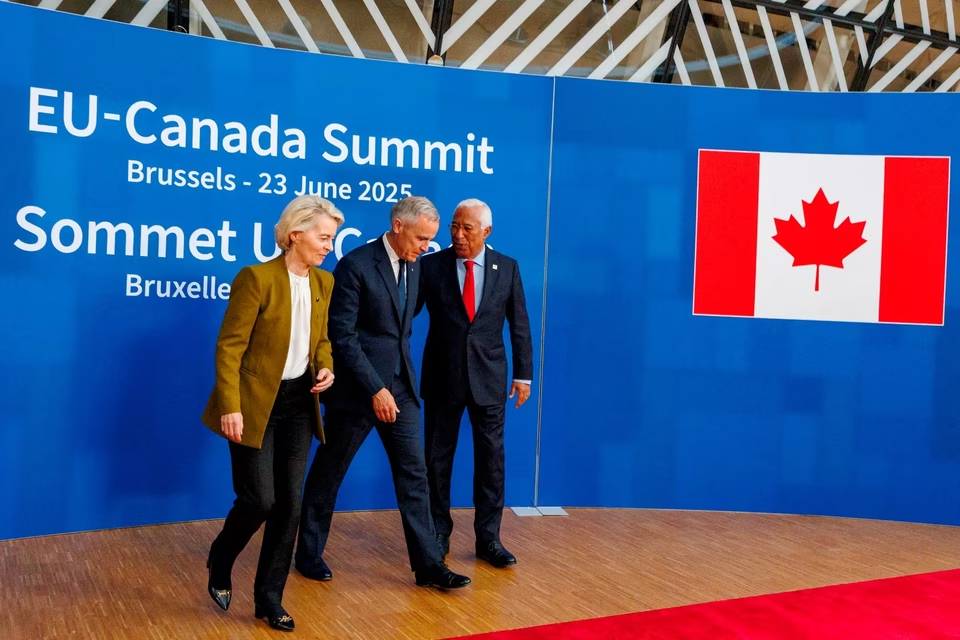
- The 21st Canada-EU summit took place in Montreal on October 29 and 30, 2026, attended by Canadian Prime Minister Mark Carney, European Council President António Costa and European Commission President Ursula von der Leyen. (consilium.europa.eu)
- The leaders launched an “Alliance for the Future” covering six areas: trade and regulation; digital and research technologies; critical resources and energy; financial services; security and preparedness; and people-to-people ties. (consilium.europa.eu)
- They agreed to define by the 2027 summit an “ever-closer association” between Canada and the EU, short of full EU membership. (ec.europa.eu)
- Negotiations were concluded on digital trade and competition agreements, while Canada joined the European High-Performance Computing Joint Undertaking. (consilium.europa.eu)
Before the summit, the defining political question was whether Canada and the European Union were preparing to create an unprecedented form of associate membership. The completed summit produced a more cautious answer. Carney continued to use the membership language, but the joint statement committed only to defining an “ever-closer association” short of full membership by the 2027 summit. The distinction reflects a real institutional constraint: Canada and the EU can deepen cooperation quickly in selected sectors, but creating a formal category with consequences across EU law, budgets and member-state authority is substantially harder. (ec.europa.eu)
That does not make the Montreal outcome merely symbolic. The alliance establishes a mechanism for treating economic security as a shared political project rather than a collection of conventional trade negotiations. Its sector-by-sector and reciprocity-based approach is designed to align Canadian resources and technological capabilities with European capital, research infrastructure and regulatory power. The joint statement explicitly connects resilient supply chains with foreign and security policy, including cyber cooperation, critical infrastructure and efforts to prevent technology leakage. (consilium.europa.eu)
For Canada, the mechanism offers diversification rather than separation from the United States. The EU is Canada’s second-largest partner for goods and services, but the scale of Canada-US economic integration means Europe cannot quickly replace the American market. Ottawa’s more attainable objective is to gain alternative sources of investment, technology and demand in sectors where dependence on a single partner creates political vulnerability. Critical minerals, digital infrastructure, finance, defence procurement and scientific computing fit that strategy because government rules and public investment strongly influence access. (international.gc.ca)
For the EU, Canada offers politically aligned access to energy, raw materials, research capacity and North American industrial networks. It also provides Brussels with a partner for defending multilateral institutions and coordinating responses to economic coercion. The alliance is consequently both economic and constitutional in the broad sense: it attempts to increase each side’s ability to make policy without yielding to pressure from larger powers. The joint declaration nevertheless says the arrangement should complement relations with other partners, limiting the evidence for interpreting it as a formal anti-US bloc. (pm.gc.ca)
A credible counterpoint is that the summit announced more than twenty measures and completed negotiations in several areas, suggesting the relationship already has significant substance. Yet the record mixes completed negotiations, participation decisions, framework agreements, exploratory studies and future bargaining. Access to supercomputing and the investment framework are concrete advances; a possible transatlantic data cable, expanded LNG exports, broader financial access and an enhanced mobility regime remain conditional. (pm.gc.ca)
The bounded judgment is therefore that Montreal created institutional direction, not a finished political settlement. Its durability will be measured by whether bureaucracies, legislatures and markets implement reciprocal access without reopening disputes that have delayed full CETA ratification.
Context / evidence
The new framework builds on CETA, which has operated provisionally since September 2017. Canadian government data show that combined goods and services trade reached C$178.6 billion in 2025 and that bilateral merchandise trade had risen by more than 77 percent from 2016. However, CETA’s full ratification remains unfinished in several EU member states, demonstrating how national politics can constrain even an established Canada-EU agreement. (international.gc.ca)
The strongest evidence of substantive movement is therefore not the alliance label but the accompanying institutional steps: a framework for European Investment Bank participation in Canadian critical-minerals projects, planned talks on financial-market access and payment systems, expanded border cooperation, and proposed work on research and youth mobility. (pm.gc.ca)
Impact
The immediate institutional effect is a denser negotiating agenda spanning departments, European Commission services, EU member governments, regulators and financial institutions. That creates additional channels for decisions on industrial finance, data rules, research access and border cooperation, but it also multiplies potential veto points. (pm.gc.ca)
For businesses and researchers, concluded digital-trade negotiations and Canadian participation in EuroHPC could eventually reduce regulatory friction and expand access to computing infrastructure. Those benefits should not yet be treated as universal or immediate: the record does not establish implementation dates or measured economic outcomes. Politically, the summit gives Ottawa and Brussels a common framework for coordinating sovereignty-related decisions without committing Canada to EU accession.
Outlook
The first test will be whether the March 2027 ministerial and commissioner-level meetings described by Carney produce agreed terms before his expected participation in European Council meetings in June. A second test will be whether the digital trade and competition agreements move from concluded negotiations to signature, approval and operation. (apnews.com)
Progress on critical-minerals financing, financial-market access, research participation and youth mobility would indicate that the framework is becoming operational. Persistent disagreement over terminology, market reciprocity or national ratification would instead produce a looser partnership: politically visible and strategically useful, but governed through separate sectoral arrangements rather than a new institutional status.