Apple Accelerated China’s Electronics Power, but It Did Not Build It Alone
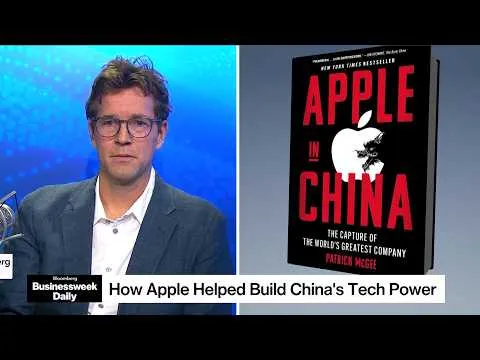
Patrick McGee’s account highlights a real transfer of manufacturing capability from Apple into China’s supplier base. But Apple was an accelerator within a larger state-backed industrial system, not the sole architect of China’s technological rise.
Overview
Apple materially accelerated the development of China’s advanced-electronics manufacturing capabilities by combining enormous purchasing volume with embedded engineering, specialized equipment and repeated production challenges. That is a narrower and better-supported conclusion than saying Apple “built” China’s technology power. China’s government, infrastructure, workforce and wider foreign-investment ecosystem supplied essential conditions. The resulting capabilities now constrain how quickly Apple can diversify and illustrate how commercial supply chains can become channels for durable industrial knowledge.
Facts
- Bloomberg published its interview with Patrick McGee on October 16, 2026; an RSS record circulated it on October 19. The discussion concerns McGee’s 2025 book, not a newly disclosed Apple investment. (bloomberg.com)
- Apple’s 2025 Form 10-K said a significant majority of its manufacturing was performed partly or wholly by partners primarily in mainland China, India, Japan, South Korea, Taiwan and Vietnam. (sec.gov)
- The filing said final assembly of substantially all Apple hardware depended on partners primarily in Asia and warned that supply-chain changes require considerable time and resources. (sec.gov)
- A 2025 U.S.-China Economic and Security Review Commission report said Apple had embedded engineers at more than 1,600 Chinese partners and sometimes purchased advanced supplier machinery. (uscc.gov)
- Apple announced a four-year, $600 billion U.S. spending and investment commitment in August 2025, including a program intended to expand domestic production of critical components. (apple.com)
Main narrative
The important part of Apple’s relationship with China was not simply that Chinese factories supplied inexpensive labor. Apple required suppliers to manufacture novel products at enormous scale, within narrow tolerances and unforgiving launch schedules. Meeting those requirements involved engineers, machinery, quality systems, logistics and continuous experimentation. According to the U.S.-China Economic and Security Review Commission, Apple embedded engineers across more than 1,600 Chinese partners, helped improve production efficiency and, in some cases, bought advanced machinery. (uscc.gov)
That creates a recognizable mechanism for industrial upgrading. A supplier solving a difficult glass-cutting, machining or assembly problem does not lose that knowledge when an Apple production run ends. Processes become embedded in equipment, managers, technicians and nearby subcontractors. Employees move between companies. Toolmakers reuse techniques. Large orders justify capital investment that smaller customers could not support. Over successive product generations, the network becomes faster at converting designs into manufacturable products.
Apple therefore contributed something more consequential than factory employment: sustained demand for learning by doing. China, however, supplied the environment that allowed those lessons to spread. Local and central governments offered infrastructure, financing, worker recruitment and incentives. Taiwanese contract manufacturers brought their own expertise. Chinese companies supplied an increasingly broad range of components, while other foreign customers added demand. Apple’s role was to intensify and organize capabilities inside an industrial system that had multiple causes.
This distinction matters because it explains both the scale of Apple’s influence and its limits. Apple could raise the frontier for consumer-electronics production without causing China’s parallel advances in sectors such as shipbuilding, rail, renewable energy or aerospace. Even within electronics, a causal estimate would have to separate Apple’s effect from state policy, China’s 2001 entry into the World Trade Organization, investment by other multinationals and the growth of domestic firms.
The same process also generated path dependence. Once engineering teams, tooling specialists, component suppliers and assembly capacity accumulated in one region, moving production became more difficult than transferring a purchase order. Apple’s 2025 annual report acknowledges that supply-chain changes are expensive, time-consuming and disruptive, while substantially all hardware final assembly remained with partners primarily in Asia. (sec.gov)
Apple has pursued alternatives. Its American Manufacturing Program targets semiconductors, glass, magnets and other critical components, while its wider supply chain includes India, Vietnam and several East Asian economies. (apple.com) But component investment and additional assembly locations do not automatically reproduce the dense network of process knowledge built through decades of production in China. The strategic consequence is reciprocal dependence: China benefited from Apple’s standards, capital and engineering, while Apple became dependent on capabilities its own orders helped deepen.
Context / evidence
McGee’s book provides the reporting thesis, while Apple’s filings establish present exposure rather than historical causation. The commission report supplies specific examples of engineering and equipment support, although it draws partly on outside reporting. OECD research explains why this mechanism is plausible: multinational investment can produce knowledge spillovers when domestic suppliers learn through purchasing relationships, strategic partnerships and workforce links. (oecd.org) These sources support an accelerator argument; none establishes that Apple was necessary or sufficient for China’s wider industrial rise.
Counterpoint / knowledge gaps
The strongest alternative is that Apple followed, rather than created, China’s industrial ascent. China already offered infrastructure, large labor pools, Taiwanese contract manufacturers, policy support and business from many other multinationals. UNIDO estimates that China produced 31.8% of global manufacturing value added in 2023, a scale no single customer can explain. (unido.org) The evidence establishes capability transfer but cannot precisely isolate Apple’s contribution. Supplier-level data comparing Apple and non-Apple factories—covering productivity, patents, employee movement, equipment and customers—could strengthen or overturn the judgment.
Impact
For Apple, the immediate consequence is reduced freedom of action during trade or geopolitical disruption: moving capacity can carry cost, timing and quality risks. For Chinese suppliers, accumulated expertise can support work for domestic and international brands, although firms exposed heavily to Apple remain vulnerable to diversification. For governments seeking reshoring, the lesson is that subsidies and factories are insufficient by themselves. Competitive ecosystems also require anchor customers, skilled workers, tooling firms and repeated collaboration between product designers and production engineers.
Outlook
Diversification should be judged by capabilities, not announcement totals. The clearest indicators will be whether suppliers outside China can assume tooling, process development and component engineering—not merely final assembly—while meeting Apple’s launch schedules, yields and costs. Faster development of such clusters would weaken China’s leverage and the path-dependence judgment. Persistent reliance on Chinese tooling, subcomponents and engineering teams would support it. Apple’s U.S. program may deepen selected domestic capabilities, but its published scope does not yet establish replication of China’s full electronics ecosystem.
Sources
- Bloomberg: How Apple Helped Build China’s Tech Power
- Apple 2025 Form 10-K
- U.S.-China Economic and Security Review Commission: Interlocking Innovation Flywheels
- Apple increases U.S. commitment to $600 billion
- OECD: Foreign Direct Investment Qualities and Impact
- UNIDO International Yearbook of Industrial Statistics 2024
- Simon & Schuster: Apple in China by Patrick McGee
- How Apple Helped Build China’s Tech Power