Alphabet’s $500 Billion Wipeout Shows AI Has Changed the Burden of Proof
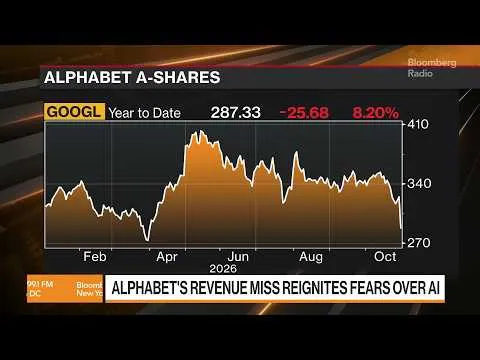
Alphabet’s record selloff reflects a harsher investor test: rapid AI growth must now protect search economics while generating returns sufficient to justify unprecedented infrastructure spending.
Overview
Alphabet’s October 29 selloff was not evidence that artificial intelligence has already destroyed Google Search. It was a repricing of two connected risks: AI-driven search activity is currently monetizing less effectively, while the infrastructure required to compete is absorbing more cash. The quarter also contained strong counterevidence, including rising search revenue, record query growth and rapidly expanding cloud sales. The bounded judgment is that AI has raised Alphabet’s execution burden rather than established a structural decline.
Facts
- Alphabet released results for the quarter ended September 30 on October 28, reporting revenue of $127.6 billion, up 25% year over year, and operating income of $40.6 billion, up 30%. (publicnow.com)
- Google Search and other revenue rose 12% to $63.35 billion, YouTube advertising revenue reached $11.21 billion, and total Google advertising revenue was $82.01 billion. Google Cloud revenue more than doubled to $30.71 billion. (publicnow.com)
- Alphabet’s Class A shares closed down 12.6% on October 29, their worst trading day on record, removing more than $500 billion from the company’s market value. (axios.com)
- Quarterly capital expenditure of about $51.4 billion exceeded operating cash flow of about $42.3 billion, producing negative free cash flow of approximately $9.1 billion. (ppc.land)
Alphabet’s record one-day loss followed a quarter that was not conventionally weak. Revenue and operating income grew, search advertising remained larger than a year earlier, and Google Cloud delivered exceptional expansion. The selloff instead reflected a change in what investors require from a company financing one of the world’s largest AI buildouts.
The causal mechanism begins inside search. Generative interfaces can increase engagement by letting users ask longer, more complex questions. But additional queries do not automatically produce proportional advertising revenue. Conventional search developed around pages of links and established commercial placements. Conversational answers offer fewer mature ad formats, and inserting advertising too aggressively could reduce usefulness or trust. Alphabet acknowledged that rapidly growing AI Mode usage currently carries lower monetization. (investing.com)
That gap matters because search advertising finances Alphabet’s wider investment program. Google must build data centers, acquire computing equipment and expand custom-chip capacity both to defend search and to meet cloud demand. Capital expenditure consequently exceeded operating cash generation during the quarter, leaving free cash flow negative for a second consecutive period. Alphabet therefore faces pressure from both sides: spending too little could weaken its competitive position, while spending heavily without preserving advertising economics reduces near-term returns. (investing.com)
The earnings miss made that trade-off visible. Total revenue and advertising sales fell below analysts’ expectations even as cloud exceeded forecasts. Search revenue still increased, but its year-over-year growth slowed from 17% in the second quarter to 12% in the third. (relevantaudience.com) For investors valuing Alphabet partly on the durability and cash generation of search, slower monetization carries more weight when infrastructure commitments are rising.
There is, however, a credible less-bearish interpretation. The quarter did not establish that users are abandoning Google. Alphabet said search-query growth accelerated, while Cloud revenue more than doubled and generated $11.1 billion in operating income. (publicnow.com) Net income was also depressed by an $8.7 billion loss on equity investments rather than solely by deterioration in operating performance. (apnews.com) The market reaction may therefore reflect elevated expectations and uncertainty about investment returns, not a confirmed collapse of the underlying franchise.
That distinction is central. AI is simultaneously increasing demand for Alphabet’s products, creating a new cloud revenue stream and changing how its most profitable service presents information. The company’s challenge is not merely to attract AI users. It must turn that usage into commercial intent and advertising inventory without degrading the experience, while ensuring that cloud and other AI revenues ultimately cover the infrastructure needed to deliver them. The October 29 plunge shows that investors are no longer treating usage growth or model capability alone as sufficient evidence.
Context / evidence
The strongest evidence for the market’s concern is the mismatch between usage and monetization. Alphabet said year-over-year search-query growth was its fastest in five years, yet search revenue growth slowed from the previous quarter. Chief Business Officer Philipp Schindler said strong growth in AI Mode queries affected results because monetization in that interface was lower. (stockanalysis.com) The strongest alternative evidence is commercial: Google Cloud revenue rose 103%, and Alphabet’s operating income still increased substantially. Those figures challenge any claim that its AI strategy is simply destroying value.
Impact
The immediate observed consequence was financial: Alphabet suffered its largest one-day market-value loss, and its decline weighed on major US equity indexes. (apnews.com) Strategically, the quarter increases scrutiny of spending allocation, AI advertising design and the pace at which cloud contracts become revenue and cash. For advertisers, lower monetization in AI Mode suggests that conversational search inventory remains under development. For shareholders, cloud growth now has to be assessed against capital intensity rather than revenue growth alone. No reported evidence yet establishes a corresponding reduction in Alphabet’s planned AI investment.
Outlook
The decisive indicators will be search revenue growth relative to query growth, advertising yields inside AI Mode, quarterly free cash flow and the conversion of cloud demand into durable profit. A recovery in AI-search monetization alongside continued cloud expansion would support Alphabet’s argument that the transition is additive. Continued query growth without corresponding advertising growth, combined with rising capital expenditure and negative cash flow, would strengthen the structural-risk case. Management has said 2027 capital spending will increase significantly but has not yet quantified it, making the next spending forecast an important valuation test. (apnews.com)